

.png)
.png)
Real-time inventory tracking helps Shopify merchants avoid stockouts, lost sales, and unhappy customers. By updating inventory levels instantly across all sales channels, it eliminates overselling, reduces errors, and ensures products are available when customers want them. Tools like Forstock offer features like automated low-stock alerts, AI-driven demand forecasting, and purchase order automation to simplify inventory management. This approach prevents stockouts, improves order fulfillment, and saves time previously spent on manual processes.
Key Takeaways:
- What causes stockouts? Inventory mismatches, delayed restocking, and demand spikes.
- Why do stockouts hurt? Lost revenue, abandoned carts, negative reviews, and wasted ad spend.
- How does real-time tracking help? It syncs inventory across platforms, provides accurate data, and automates replenishment.
- Benefits: Fewer stockouts, reduced manual work, and better customer satisfaction.
Real-time tracking is essential for keeping up with fast-moving e-commerce demands. It ensures accurate inventory counts, streamlines operations, and keeps customers happy by preventing the frustration of unavailable products.
Transparency in Action: Smarter Decisions with Real-Time Inventory Tracking
The Limitations of Static Inventory Tracking
A surprising number of Shopify merchants still rely on outdated inventory management methods - manual counts, spreadsheets, or systems that update only at the end of the day. These static tracking methods can't keep up with the fast-paced nature of modern e-commerce. When demand suddenly spikes, this approach often leads to overselling and stockouts. For U.S.-based Shopify merchants juggling multiple sales channels - like your online store, Amazon, Walmart Marketplace, wholesale accounts, and physical retail locations - this issue becomes even more pronounced. Each channel may have its own inventory count, and without real-time synchronization, one platform could oversell while another sits on unused stock that might have prevented a shortage. The fallout? Missed sales, unhappy customers, and inventory discrepancies that are tough to untangle. These problems often snowball, with human errors compounding the inaccuracies.
The Problem with Manual Processes
Manual inventory management has one major flaw: it's prone to human error. Mistakes and delays in updating stock can drop accuracy levels to as low as 70–80%, significantly increasing the chances of overselling.
Even small errors at the SKU level can cause big headaches. For instance, if a merchant exports daily orders, updates stock levels in a spreadsheet, and then re-imports the data into Shopify or a warehouse system, there's a substantial time gap during which the on-screen inventory doesn't match what's actually available. This mismatch can wreak havoc on popular items, leading to stockouts and frustrated customers.
The issue is compounded by outdated safety stock practices. Many merchants set safety stock levels and reorder points based on historical averages, updating them only once a year or quarter. Static tracking systems can't adapt to real-time sales trends. So, if a product unexpectedly becomes a bestseller - thanks to a TikTok mention, email campaign, or viral social media post - it can deplete safety stock much faster than anticipated. By the time the system flags a reorder, you're already out of stock and scrambling to recover.
Another major challenge is disconnected inventory data across sales channels. When each channel operates independently, merchants lose sight of the bigger picture - like total available stock, reserved units, or inventory in transit. One channel might oversell because it’s unaware of a large wholesale order or in-store purchases, while another channel holds unused buffer stock that could have prevented a sellout.
As your product catalog grows - adding SKUs, sizes, colors, and variants - keeping manual systems accurate becomes even harder. Some merchants try to simplify by grouping variants or skipping real-time updates altogether, but both approaches increase the risk of stockouts. A single spreadsheet error can cascade through your operations, leaving you with inaccurate inventory counts and unfulfilled orders.
Challenges in Managing U.S. Fulfillment
The complexities of U.S. fulfillment amplify the problems caused by static inventory tracking. Many Shopify merchants distribute inventory across multiple locations - coastal warehouses, regional third-party logistics providers (3PLs), and micro-fulfillment hubs - to speed up delivery times and reach more customers. This multi-location strategy demands constant synchronization of on-hand, reserved, and inbound units at each site. But static tracking, which relies on end-of-day updates from each partner, often results in delays and mismatched data. You might accidentally allocate stock from a California warehouse that’s already committed to other orders or miss the fact that a high-demand SKU is nearly sold out in a key region.
Variable supplier lead times and shipping delays add another layer of complexity. Inconsistent lead times at U.S. ports or within domestic transport can fluctuate by days or even weeks due to congestion, labor strikes, bad weather, or limited carrier capacity. Static systems that assume fixed lead times - like 30 or 45 days - can’t account for these disruptions. This often results in orders being placed too late. When containers get stuck at West Coast ports or trailers are delayed in transit, prolonged stockouts occur - issues that could have been avoided with real-time visibility into supplier performance and logistics.
Static tracking also struggles to handle the rapid shifts in demand common in today’s retail landscape. During high-pressure events like Black Friday or Cyber Monday, a single SKU might sell a week’s worth of inventory in just a few hours. With static updates, your system might show healthy stock in the morning, only to oversell by midday as it fails to keep up with the surge in sales.
Unexpected demand spikes from influencer mentions, viral posts, or paid ad traffic pose similar challenges. By the time a spreadsheet or end-of-day report flags the issue, you may already have backorders piling up, leaving customers waiting weeks for fulfillment.
For merchants using 3PLs or managing multiple U.S. fulfillment locations, static tracking leads to fragmented visibility. You might find that the "wrong" warehouse runs out of stock first, resulting in split shipments, longer delivery times, and lost sales. Without real-time data, it’s impossible to dynamically allocate inventory to where it’s needed most. This creates a scenario where some regions experience stockouts while inventory sits idle elsewhere.
Static tracking forces merchants to react to problems instead of preventing them. By the time you notice a stockout in a spreadsheet or receive a low-stock alert, customers may have already tried to purchase items you can’t deliver. Real-time inventory platforms like Forstock eliminate these blind spots by instantly syncing stock movements from Shopify orders, returns, and transfers. This ensures accurate, up-to-date inventory counts across all sales channels and locations. By incorporating AI-driven forecasting, automated purchase orders, and supplier performance analytics, Forstock helps merchants stay ahead of demand, adjust for variable lead times, and avoid stockouts - without overloading shelves with excess inventory.
How Real-Time Tracking Prevents Stockouts
Real-time inventory tracking updates stock levels instantly with every transaction. This means every sale, return, transfer, or adjustment is recorded the moment it happens, rather than waiting for end-of-day updates. For businesses, this is a game-changer. It ensures that your Shopify store, marketplaces, and physical locations all pull from the same inventory data, eliminating the risk of overselling or phantom stock issues that often lead to stockouts.
For example, when a customer places an order, the system instantly adjusts the available stock count. This accuracy is especially important during high-traffic events like Black Friday or flash sales, where hundreds of orders can pour in within minutes. Real-time tracking keeps up with these spikes, ensuring customers can only purchase items that are actually available. This level of precision is something manual processes simply can't match.
But real-time tracking does more than just prevent overselling. It also identifies low-stock situations early. Unlike traditional systems that might alert you too late - after you've already sold out - real-time platforms monitor sales trends and inventory levels continuously. They can trigger alerts when stock falls below a set threshold, accounting for supplier lead times and daily sales patterns. This early warning system allows merchants to reorder, expedite shipments, or redistribute stock from other locations before hitting zero. It’s a proactive approach that’s essential for managing inventory across multiple sales channels.
Real-Time Visibility Across Channels
For U.S.-based Shopify merchants juggling multiple sales channels - online stores, Amazon, Walmart Marketplace, wholesale accounts, and physical stores - real-time inventory synchronization is a must. It ensures every channel pulls from the same centralized stock pool. For instance, if a unit sells at your Austin store, your Shopify product page in New York reflects the change instantly. This eliminates fragmented inventory counts that could cause one channel to oversell while another holds excess stock.
Imagine running a flash sale on Instagram, driving a surge of traffic to your Shopify store, while your Amazon listings remain active and a wholesale partner submits a bulk order. Without real-time tracking, each channel might assume it has access to the full inventory, leading to overselling and canceled orders. Real-time systems allocate stock dynamically across all channels, preventing this issue. When inventory gets low, the system can even hide listings or switch to backorder mode, protecting your brand’s reputation and keeping customers happy.
This visibility also improves order fulfillment. When an order comes in, the system knows exactly which U.S. warehouse or 3PL has the item in stock and routes the order accordingly. This reduces shipping costs, speeds up delivery, and avoids the frustration of sending orders to locations already out of stock. Warehouse teams can rely on accurate counts, spending less time searching for missing items and more time ensuring orders are packed and shipped correctly.
Platforms like Forstock integrate seamlessly with Shopify to provide this unified, real-time view. These platforms sync product listings, customer orders, and inventory levels across the board, consolidating everything into a single dashboard. Merchants gain instant insights into inventory health, turnover rates, and stock value at each location. Emily, an inventory manager using Forstock, explains:
"I open the dashboard in the morning and instantly know what needs reordering, what is overstocked, and what to focus on."
This kind of visibility simplifies managing complex, multi-location operations, turning scattered data into actionable insights that help prevent stockouts.
Automated Alerts and Replenishment
Real-time tracking doesn’t just keep tabs on inventory - it also automates key aspects of inventory management. With real-time updates, merchants can adjust for variable lead times and maintain optimal stock levels. Low-stock alerts are triggered when inventory for a product falls below a calculated threshold based on daily sales, supplier lead times, and desired safety stock levels. These alerts give merchants enough time to place orders, coordinate with suppliers, and receive stock before running out.
Dynamic reorder points take it a step further, automatically adapting to changes in demand or supply conditions. For instance, if a product’s sales skyrocket due to a viral TikTok post, the system recalculates reorder points to match the new demand. Similarly, if a supplier’s lead time increases because of shipping delays, the system adjusts reorder points to ensure stock levels remain stable. This flexibility is especially valuable for U.S. merchants navigating challenges like port delays or seasonal demand shifts.
Automated purchase orders make the replenishment process even smoother. Instead of manually monitoring stock levels and emailing suppliers, merchants can set rules that generate purchase orders automatically when inventory hits predefined triggers. Forstock’s AI-powered forecasting tools analyze real-time sales data and historical trends to recommend the best order quantities and timing. The platform simplifies the process with one-click POs, supplier tracking, and Shopify integration, eliminating the need for time-consuming spreadsheets.
Sophie, an e-commerce manager, shares her experience:
"Before Forstock, I was literally living in spreadsheets. I spent hours each week updating stock levels and trying not to miss reorder points. Since switching, I haven't had a single stockout, and I don't overorder anymore. The AI forecast actually makes sense for my business. It feels like having a supply chain manager on my team."
These automated workflows are especially helpful during peak shopping periods like Cyber Monday or back-to-school season. Real-time data paired with demand forecasts enables merchants to adjust purchase orders weeks in advance, giving suppliers more lead time and reducing the need for costly expedited shipping. Instead of scrambling to restock after selling out, merchants can maintain the right inventory levels throughout the season, boosting sales and customer satisfaction.
For Shopify brands managing multiple warehouses or 3PLs, automated alerts and replenishment ensure that inventory transfers, wholesale orders, and direct-to-consumer sales all operate from a single, accurate source of truth. The system tracks stock in transit, reserved units, and available inventory at each location, preventing scenarios where one warehouse runs out while another has excess. Merchants can customize reorder rules for each location, accounting for regional demand, shipping times, and supplier proximity.
Comparison: With vs. Without Real-Time Tracking
Switching from static to real-time inventory tracking can significantly improve operations and prevent stockouts. Merchants using real-time systems often experience fewer stockouts, higher fulfillment rates, and fewer canceled or backordered orders. These benefits translate into better customer reviews, fewer "out of stock" moments, and increased repeat purchases - key advantages in competitive industries like apparel, beauty, and electronics.
| Aspect | Without Real-Time Tracking | With Real-Time Tracking |
|---|---|---|
| Inventory accuracy | Relies on periodic counts; prone to errors and 20–30% inaccuracies | Updates with every transaction, ensuring reliable on-hand counts |
| Stockout frequency | Frequent due to outdated records and slow replenishment | Rare, thanks to proactive alerts and dynamic reorder points |
| Overselling/backorders | Common when channels use unsynced inventory, leading to cancellations | Minimal, as all channels share a single, real-time inventory pool |
| Order fulfillment speed | Delays caused by inaccurate stock counts and manual processes | Faster, with trusted system data guiding fulfillment |
| Customer satisfaction & loyalty | Lower, due to stockouts and order cancellations | Higher, as promised items are available and ship on time |
| Labor & admin workload | Heavy, with manual updates and error-prone spreadsheets | Reduced, with automated updates and streamlined processes |
sbb-itb-f0fc809
Key Features of a Real-Time Tracking System
A good real-time tracking system can mean the difference between constant stock shortages and smooth, reliable operations. For Shopify merchants, it’s not just about tracking inventory; it’s about having tools that combine automation, forecasting, and real-time visibility. When choosing a solution, focus on three key aspects: seamless Shopify integration with multi-location support, AI-powered automation and analytics, and tools designed to prevent stockouts through proactive planning. These features are the backbone of effective inventory management.
Integration with Shopify and Multi-Location Support

The effectiveness of any real-time tracking system hinges on how well it integrates with your existing tools. For Shopify merchants, this means a platform that directly connects to your store, automatically syncing stock levels, orders, and product data. Whether it’s a new order, a return, or an inventory adjustment, the system should instantly update across all sales channels and physical locations without requiring manual input.
For businesses in the U.S. that operate across multiple locations - be it warehouses in California, Texas, and New Jersey, or third-party logistics providers - multi-location support is critical. This feature provides real-time visibility into stock levels at each site, rather than offering a single aggregated number. Such visibility enables smarter order routing, sending products from the nearest location to the customer, which helps cut delivery times and shipping costs. Additionally, location-specific reorder points and allocation rules ensure that each warehouse maintains appropriate stock levels based on factors like regional demand, supplier proximity, and lead times.
Matt, a solo founder using Forstock, shared how seamless Shopify integration changed his workflow:
"It is user-friendly, plugs right into Shopify, and makes me feel in control. I finally stopped panicking about stockouts, and I can focus on marketing and sales instead of constantly worrying about inventory."
This level of integration eliminates the need for tedious manual updates or juggling spreadsheets, giving businesses a single, reliable source for inventory management.
AI-Driven Automation and Analytics
Once Shopify integration is in place, AI-driven automation takes inventory management to the next level. As your business grows, relying on guesswork or static reorder points becomes unsustainable. AI automation uses historical sales data, seasonal trends, promotions, and supplier lead times to forecast demand and recommend when and how much to reorder. Instead of manually calculating stock needs, merchants receive precise, data-backed recommendations tailored to their business.
For example, AI-powered forecasting can analyze Shopify sales history to spot trends and adjust for seasonal spikes, like holiday shopping in Q4 or summer demand surges. If a product suddenly gains popularity or a promotion drives unexpected sales, the system recalibrates forecasts in real time, ensuring reorder points are always up to date. This proactive approach keeps stock levels balanced without the need for constant monitoring.
Automated purchase order workflows save even more time. When inventory dips below safe thresholds, the system suggests purchase orders, pre-filled with supplier details, lead times, costs, and delivery locations. Merchants can quickly review and approve these orders, cutting down hours typically spent managing spreadsheets. The system also tracks purchase order statuses and expected delivery dates, sending alerts if shipments are delayed. This allows businesses to adjust safety stock or marketing plans before stockouts occur.
On top of forecasting and purchase orders, analytics dashboards provide a clear view of key metrics like stockout rates, inventory turnover, days of supply, and lost sales from out-of-stock items. Supplier performance metrics, such as average lead times and on-time delivery rates, help merchants identify reliable partners while flagging those who may need backup during busy periods. Exception reports highlight items at risk of running out in the next 7, 14, or 30 days, enabling merchants to prioritize replenishment for high-risk products.
Emily, an inventory manager, explained how these tools simplify her day:
"I open the dashboard in the morning and instantly know what needs reordering, what is overstocked, and what to focus on."
These insights transform raw data into actionable strategies, helping businesses refine purchasing decisions, optimize safety stock, and improve forecasting accuracy over time.
How Forstock Eliminates Stockouts
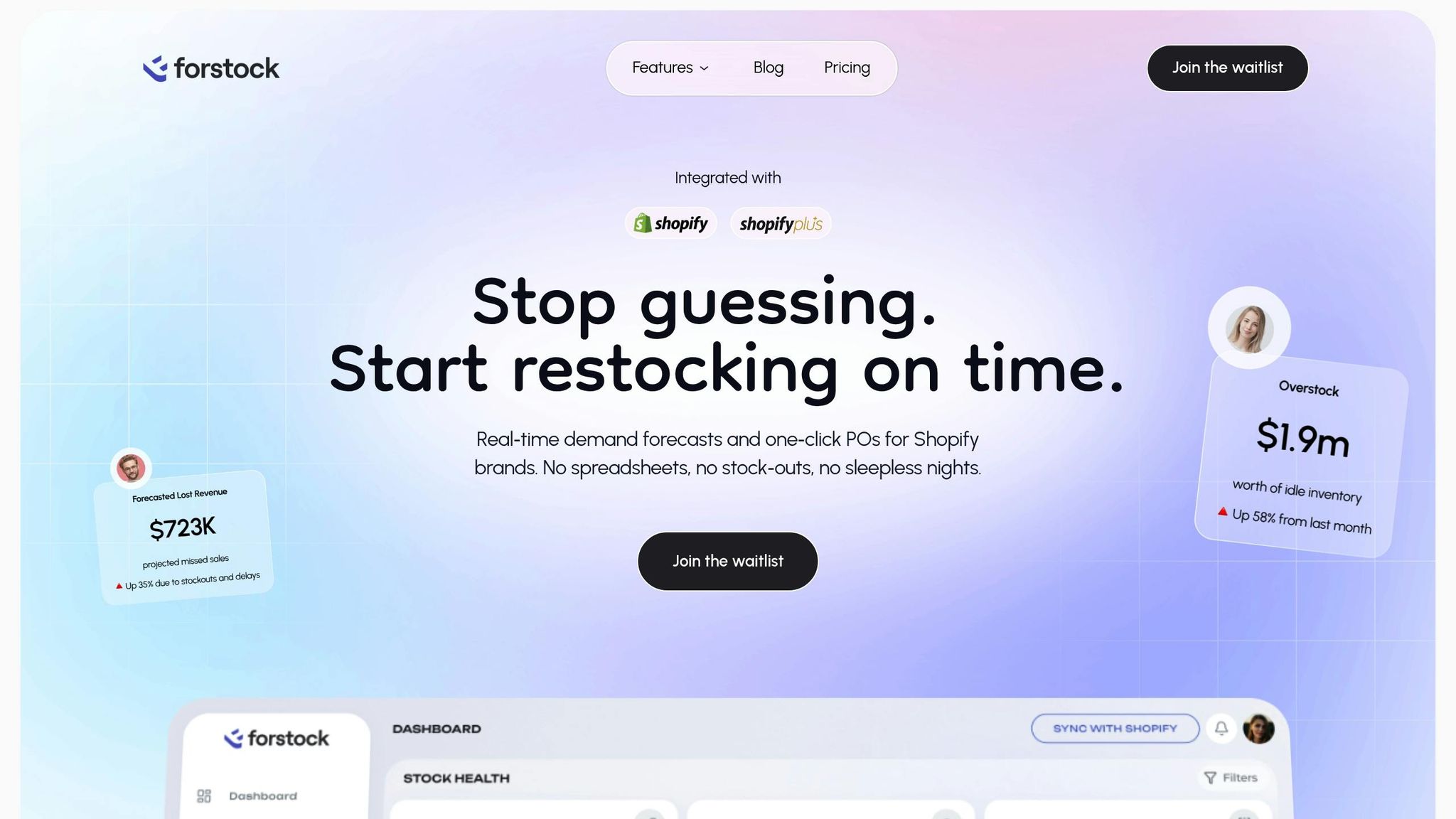
Forstock combines real-time tracking with AI-driven insights to eliminate stockouts and streamline inventory management. Designed with Shopify merchants in mind, the platform integrates tracking, forecasting, and automated purchase order workflows into a single system connected directly to Shopify. This unified dashboard provides instant updates on inventory health, supplier performance, and open purchase orders.
Forstock’s AI models analyze Shopify sales data, factoring in seasonality, promotions, and regional demand patterns across the U.S. The system generates demand projections for the next 3 to 12 months, offering reorder recommendations that consider supplier lead times, minimum order quantities, and safety stock levels. This approach reduces both stockouts and excess inventory that can tie up cash flow.
Real-time alerts notify merchants before stockouts happen, using live sales data and lead times to determine when reorders are needed. Instead of reacting to customer complaints about unavailable products, merchants can act early - placing orders, expediting shipments, or adjusting marketing strategies to prevent inventory shortages.
Daniel, a supply chain manager, shared how Forstock has improved his operations:
"With Forstock, we can create POs in minutes, track supplier performance, and forecast demand without the guesswork. It is the first tool that actually bridges inventory management and purchasing instead of forcing us to hack things together."
The platform also centralizes supplier management, storing records, lead times, minimum order quantities, and communication history in one place. This ensures all team members have access to the same information, while tools like purchase order tracking and delivery alerts help catch delays early.
For businesses with complex catalogs or multiple warehouses, Forstock’s dashboards offer instant visibility into stock levels, turnover rates, and inventory value at each location. The system even handles Shopify’s product variants, bundles, and kits, ensuring accurate inventory counts for more intricate product setups.
Liam, an operations director, summed up the platform’s impact:
"The forecasts are accurate, the purchase order flow is seamless, and my team actually enjoys using it. We have cut manual inventory tasks by at least 60%."
Using Real-Time Data for Smarter Replenishment
Building on the earlier discussion about stockout prevention, real-time data has revolutionized how merchants approach replenishment. Instead of scrambling to react after inventory runs out, businesses can now use live sales data, supplier lead times, and demand forecasts to place orders at the right time and in the right quantities. This is particularly important for U.S. retailers juggling regional demand shifts, shipping delays, and seasonal spikes.
With real-time data, merchants gain instant insights into stock levels, sales trends, and pending orders. No more waiting for end-of-day reports or weekly inventory updates to make decisions. If a product starts selling faster than expected, the system flags it immediately and adjusts reorder recommendations before inventory dips too low. This ensures shelves stay stocked, even during busy hours when a sudden rush could otherwise leave customers empty-handed.
Another advantage? Real-time systems prevent overselling across multiple channels. Whether it’s Shopify, online marketplaces, or in-store point-of-sale systems, inventory updates happen instantly, eliminating the risk of selling the same item twice.
But it’s not just about avoiding stockouts. Real-time data also highlights slow-moving products that tie up capital. Merchants can quickly spot these underperforming items and take action - whether that’s running promotions, bundling products, or adjusting future orders. Balancing stock levels with this dual focus keeps inventory lean and cash flow steady.
Seasonal and Trend-Based Planning
U.S. retailers face major seasonal peaks like Black Friday, Cyber Monday, Christmas, back-to-school, and summer shopping. During these periods, demand can surge dramatically, making real-time tracking essential for staying ahead. Merchants can compare live sales data against forecasts and previous year’s performance, spotting early trends that indicate demand is higher - or lower - than expected.
For instance, if a product sells 30% faster than forecast during the first hours of a Black Friday sale, real-time data allows merchants to immediately increase reorder quantities or prioritize air shipments to avoid running out mid-promotion. Without this visibility, brands often discover the issue only after customers complain about unavailable products - by then, it’s too late to course-correct.
Real-time tracking also supports regional demand planning. A direct-to-consumer apparel brand, for example, might notice a new color is selling twice as fast on the West Coast compared to the Midwest during a July Fourth promotion. With this insight, the brand can shift inventory between warehouses or boost reorders for the high-demand region, ensuring availability without overstocking. This approach accounts for varying shipping times - anywhere from 1 to 5 days depending on carrier and distance - and local demand differences, so each fulfillment center maintains optimal stock levels.
Effective seasonal planning starts with analyzing at least 12 months of order history to identify patterns around key events. Merchants can create models based on last year’s daily sales during holidays and refine them in real time using current sales data. If sales deviate by about 20% from forecasts, the system automatically adjusts projections and initiates new purchase orders.
For Shopify brands, this coordination becomes even more critical when marketing campaigns are involved. Before launching an email blast or social media ad, merchants can use real-time data to confirm inventory levels are sufficient. This avoids frustrating customers with “out of stock” messages after being directed to the site.
These proactive strategies emphasize the shift from reactive to forecast-driven replenishment, highlighting the transformative role of real-time data.
Reactive vs. Forecast-Driven Replenishment
Traditional inventory systems often rely on reactive measures, while real-time tracking enables a more forward-thinking, forecast-driven approach. The difference between these methods is striking. Reactive replenishment involves placing orders only after inventory is visibly low or already depleted, often based on gut instinct or outdated reports. This leads to emergency orders, costly expedited shipping, and missed sales opportunities. Forecast-driven replenishment, on the other hand, uses demand projections, lead times, and safety stock rules to create purchase orders before inventory levels become critical. Real-time tracking ensures these forecasts stay current, allowing systems to adjust orders as demand shifts.
Here’s a side-by-side comparison of these two approaches:
| Aspect | Reactive Replenishment | Forecast-Driven Replenishment (With Real-Time Data) |
|---|---|---|
| Data Freshness | Relies on periodic counts or delayed reports, leading to outdated decisions. | Continuously updated with real-time data from POS, online, and warehouse systems. |
| Trigger for Orders | Orders placed manually after low stock or stockout is noticed. | System predicts reorder points and auto-initiates purchase orders or transfers. |
| Handling Demand Spikes | Stockouts and emergency shipments are common due to delayed response. | Detects spikes early and adjusts orders before shelves are empty. |
| Safety Stock | Set using rough estimates, often leading to over- or understocking. | Dynamically recalculated using real-time demand and lead-time variability. |
| Labor and Error Rate | High manual effort with frequent errors and missed items. | Automation reduces manual work, minimizing errors and labor costs. |
| Cash Flow and Overstock Risk | Guesswork often results in overbuying or underbuying. | Orders align with demand, reducing excess inventory and freeing up cash. |
| Omnichannel Inventory Balancing | Limited visibility across locations, making transfers inefficient. | Real-time view supports ship-from-store and inter-store transfers. |
This comparison underscores why forecast-driven replenishment, powered by real-time tracking, is far more efficient. Reactive replenishment is crisis-driven, requiring merchants to constantly update spreadsheets, manually check stock levels, and scramble to avoid stockouts. When demand spikes unexpectedly, they’re forced into expensive rush shipping to avoid disappointing customers. Balancing inventory across locations also becomes a challenge without a real-time view of where stock is needed most.
Forecast-driven replenishment flips the script. Merchants receive automated alerts before stockouts occur, based on current sales trends and supplier lead times. Purchase orders are generated automatically, complete with supplier details, quantities, and delivery schedules. This streamlines operations, reduces errors, and ensures inventory arrives just in time to meet demand.
For merchants managing multiple fulfillment centers, real-time data must be segmented by location rather than treated as a single national pool. This allows for tailored reorder points and safety stock levels for each warehouse, accounting for regional demand and shipping times. For example, a beauty brand might use real-time sales data to shift inventory from a slower Midwest warehouse to a high-demand coastal location, ensuring smooth availability without overstocking.
To implement forecast-driven replenishment, start with a pilot group of fast-moving products. Define key metrics like stockout rates, inventory turnover, fill rates, and rush-shipping costs, and review them weekly to validate the process. Train teams to use real-time dashboards and gradually shift purchasing decisions from spreadsheets to automated systems. As more data accumulates, reorder parameters can be fine-tuned for greater accuracy.
Forstock simplifies this entire process for Shopify merchants. The platform integrates orders, returns, and stock movements to power AI-driven demand forecasts and real-time dashboards. It automatically calculates recommended purchase orders, flags SKUs at risk of stockouts, and allows merchants to approve or adjust orders directly within the interface. By reducing reliance on spreadsheets and manual work, Forstock minimizes errors and helps merchants stay ahead of demand.
Conclusion
Real-time inventory tracking is a game-changer for Shopify merchants, replacing outdated, reactive methods with smart, automated systems. By moving away from static spreadsheets and embracing data-driven platforms, businesses can minimize lost sales, improve cash flow, and keep customers happy by ensuring products are always available when needed.
Merchants adopting real-time tracking report cutting manual inventory tasks by at least 60%. This frees up valuable time to prioritize growth, marketing, and building stronger customer relationships. Automated alerts ensure teams are notified before stock runs low, while AI-powered forecasts adjust to demand, eliminating the guesswork that often leads to overstocking or stockouts. When products are consistently in stock, customer trust grows, leading to repeat purchases and long-term loyalty.
Operationally, the benefits are just as impactful. For merchants juggling multiple fulfillment centers, suppliers, or seasonal demand spikes, real-time systems bring much-needed clarity. A unified dashboard provides instant insights into stock levels, supplier performance, and open purchase orders, replacing the inefficiency of scattered spreadsheets. Merchants can quickly create and track purchase orders, shift inventory to meet regional demand, and respond instantly to unexpected sales surges during promotions or the holiday season.
This shift from reactive to proactive inventory management is a fundamental upgrade. Instead of scrambling to place emergency orders or paying for expedited shipping, merchants can plan ahead with confidence, knowing their system will alert them to potential issues before they escalate.
If you're a Shopify merchant still relying on manual processes or outdated tools, it's time to explore real-time tracking. Forstock offers a 14-day free trial and integrates seamlessly with Shopify, providing features like real-time demand forecasting, automated purchase order creation, and inventory analytics - all accessible from one dashboard. Starting at just $39/month, it’s an affordable option for businesses of all sizes. The platform’s AI-driven forecasts adapt to your unique sales patterns, lead times, and seasonal trends, ensuring every purchasing decision is backed by reliable data.
In today’s fast-moving e-commerce world, real-time tracking isn’t just an upgrade - it’s essential for staying competitive, meeting customer expectations, and freeing up time to focus on what matters most: growing your business.
FAQs
How does real-time inventory tracking help Shopify merchants prevent stockouts and keep customers happy?
Real-time inventory tracking gives Shopify merchants the ability to check stock levels instantly, helping them avoid running out of products and ensuring that popular items remain available. It provides immediate insights into inventory status, supplier reliability, and purchase order updates, enabling quicker and more informed decisions to keep shelves stocked.
This kind of system doesn't just prevent lost sales - it also improves customer satisfaction by ensuring shoppers can always find what they're looking for. With tools like AI-powered forecasting, merchants can respond to shifting demand, simplify operations, and concentrate on creating a smooth shopping experience.
How does real-time inventory tracking differ from traditional methods, and what benefits does it offer for sales and operations?
Real-time inventory tracking offers immediate updates on stock levels, supplier performance, and purchase orders, enabling businesses to adapt swiftly to shifts in demand. Unlike older static methods that depend on periodic updates, this system ensures that accurate, up-to-the-minute data is always accessible.
By catching low inventory levels early, it helps avoid stockouts, which means happier customers and fewer missed sales opportunities. Plus, it simplifies operations by automating repetitive tasks and delivering useful insights, saving time and making inventory management decisions easier and more efficient.
How do AI-driven forecasting and automated purchase orders improve inventory management for e-commerce businesses?
AI-powered forecasting enables e-commerce businesses to make more informed purchasing decisions by examining sales trends, lead times, and seasonal shifts. This means you can maintain the perfect stock levels to meet customer demand without the risk of overordering.
On top of that, automated purchase orders streamline the restocking process by taking care of repetitive tasks, minimizing errors, and ensuring smooth communication with suppliers. These tools work hand-in-hand to save time, boost cash flow, and avoid the headaches of stockouts or excess inventory.



.png)
.png)
.png)
.svg)