

.png)
.png)
Managing inventory across multiple locations is challenging, but AI tools simplify the process. Here's how AI transforms inventory management for Shopify store owners:
- Real-Time Updates: AI instantly syncs stock levels across all locations, reducing overselling and delays.
- Demand Forecasting: Machine learning predicts demand with up to 95% accuracy, helping avoid stockouts and excess inventory.
- Automation: AI automates stock adjustments, reorder points, and purchase orders, saving time and minimizing errors.
- Cost Savings: AI reduces carrying costs by 20–30% and cuts stockouts by up to 65%.
For example, brands like We Are Jolies reduced stockouts by 60%, and Cloudsharks saw a 35% drop in errors after switching to AI-powered inventory tools. AI ensures accurate inventory, better cash flow, and smoother operations, especially for businesses managing multiple warehouses or retail locations.

AI Inventory Management Impact: Key Statistics and Benefits
Common Problems in Multi-Location Inventory Management
Running multi-location Shopify stores brings a unique set of inventory challenges. One of the biggest hurdles? Data silos. When teams work with fragmented information, it creates inconsistent numbers, making it nearly impossible to get a clear view of what’s actually available to sell.
And the stakes are high. Inventory mistakes can be costly. Overstocking eats up 20–30% of your working capital in carrying costs, while stockouts not only push customers to competitors but can also lead to negative social media backlash that harms your brand. While traditional manual methods only hit 60–70% accuracy in demand predictions, machine learning systems raise that to an impressive 85–95%. These stats highlight why automated, real-time solutions are becoming essential.
Mismatched Stock Counts
Imagine your dashboard says you have 15 units of a product, but only 3 are actually in stock. This kind of mismatch frustrates customers and wastes your team’s time. The issue often stems from manual updates required for each location, which causes delays and synchronization problems. Without real-time insights across all sales channels, overselling becomes a serious risk.
Take the case of We Are Jolies, a French underwear brand. Back in December 2025, they struggled with manual tracking errors and poor coordination across multiple warehouses. These issues led to frequent stockouts as they expanded their product lines. But once they implemented AI forecasting with automated reorder alerts, stockouts dropped by 60%, and they gained real-time visibility across all locations. AI-powered tools eliminate these mismatches by instantly reconciling inventory data, ensuring accuracy across the board.
Too Much or Too Little Stock
Excess stock takes up valuable warehouse space, ties up cash flow, and often ends up as deadstock or discounted items. On the flip side, running out of popular products leads to lost sales, canceled orders, and unhappy customers.
AI-driven forecasting offers a solution. It can cut stockouts by 25% and reduce excess inventory by 30%. Brands experiencing rapid growth have reported a 15–20% increase in gross margins thanks to improved inventory turnover driven by AI. By analyzing real-time demand patterns, automated systems adjust stock levels to minimize these risks.
Manual Updates and Human Error
Relying on spreadsheets to manage inventory is a recipe for disaster. Double-counting and formula errors can throw off your entire inventory record. And by the time you’ve manually updated stock levels after a busy weekend, sales and returns may have already made that data outdated.
"New businesses often rely on spreadsheets or manual bookkeeping to manage inventory across multiple locations. This is a time-consuming and error-prone process, privy to accidental double takes or formula errors." - Prediko
Switching to automation has delivered real results for many brands. Cloudsharks, for example, reduced stockouts by 35% after moving away from manual processes. Similarly, Kate Hewko saw a 40% boost in operational efficiency by automating routine inventory tasks. Manual tracking simply doesn’t scale, and as your business grows, errors only multiply. Automated tools offer a scalable, reliable alternative.
How AI Improves Multi-Location Inventory Sync
Managing inventory across multiple locations can be a logistical headache, but AI-powered platforms are changing the game. These systems replace slow, manual processes with automation, tackling issues like overselling and delayed updates head-on. Instead of relying on batch updates that take hours, AI uses monitoring agents to instantly capture Shopify orders. The moment an order is placed, inventory is reserved in the warehouse management system. This proactive approach nearly eliminates overselling and significantly cuts down on customer cancellations.
Machine learning also steps in to improve demand forecasting, achieving accuracy rates between 85% and 95%. With AI acting as a single source of truth, sales channels are updated simultaneously, removing the need for manual adjustments across platforms.
"AI-enabled inventory management workflows... are able to continuously learn from new data and feedback humans give to the system. They get smarter over time." - Shopify Staff
AI platforms are built to scale. Whether you’re managing 10 or 10,000 SKUs, they maintain the same level of speed and precision. Surveys show that 95% of top-performing organizations consider AI essential to their success. Features like automated restocking and real-time visibility can reduce stockouts by as much as 60%, making these systems a powerful tool for businesses of all sizes.
Real-Time Stock Updates
One of AI’s standout features is its ability to keep inventory levels accurate across all locations in real time. Traditional systems often rely on batch updates, which can take hours and leave room for overselling. AI-powered tools eliminate these delays by continuously syncing data. High-frequency monitoring agents track every order and cancellation, instantly updating your warehouse management system. This ensures seller ratings and customer trust remain intact.
Advanced technologies like computer vision and robotics take this further. Warehouse cameras, drones, and autonomous robots can monitor stock levels in real time, adding another layer of accuracy. AI also performs automated reconciliation, auditing and correcting discrepancies between sales data and warehouse counts. For Shopify brands with multiple locations, this enables dynamic order routing, directing orders to the best fulfillment center based on stock availability, customer proximity, and delivery speed.
Predicting Future Demand
AI turns demand forecasting into a science. By analyzing historical sales, seasonal trends, and external factors like weather or holidays, machine learning algorithms can predict demand with up to 95% accuracy. This reduces forecast errors by 20–50%. AI even handles variant-level forecasting, predicting demand for specific SKUs like sizes or colors, while eliminating data silos common in manual systems.
For businesses with multiple locations, AI ensures stock is positioned where it’s needed most by analyzing regional demand patterns. It can even assess the impact of promotions on seasonal sales through multivariate analysis.
"Models like demand sensing, which feed real-time signals, have improved forecast accuracy by 20-50% and raised operational efficiency by up to 65% compared to static methods." - fabric Inc.
The financial benefits are hard to ignore. AI forecasting can reduce stockouts by up to 65% and cut inventory levels by 20–30%, freeing up cash flow. Retailers using AI have reported revenue growth of 3–7% within months, along with logistics cost reductions of up to 20% and procurement savings of up to 15%.
Automatic Stock Adjustments
AI doesn’t just stop at forecasting - it automates stock replenishment too. When inventory hits optimal reorder points, the system triggers purchase orders automatically, removing the need for manual decisions. Unlike static threshold alerts, AI bases its recommendations on future demand, not just current sales trends.
It also identifies regional demand patterns and suggests transferring stock between locations to balance inventory levels. For example, if one warehouse is running low and another has surplus, AI can recommend a transfer before either reaches a critical point. Even for new products without historical data, AI uses clustering algorithms to make predictions based on similar items.
How to Set Up AI-Powered Inventory Sync with Forstock
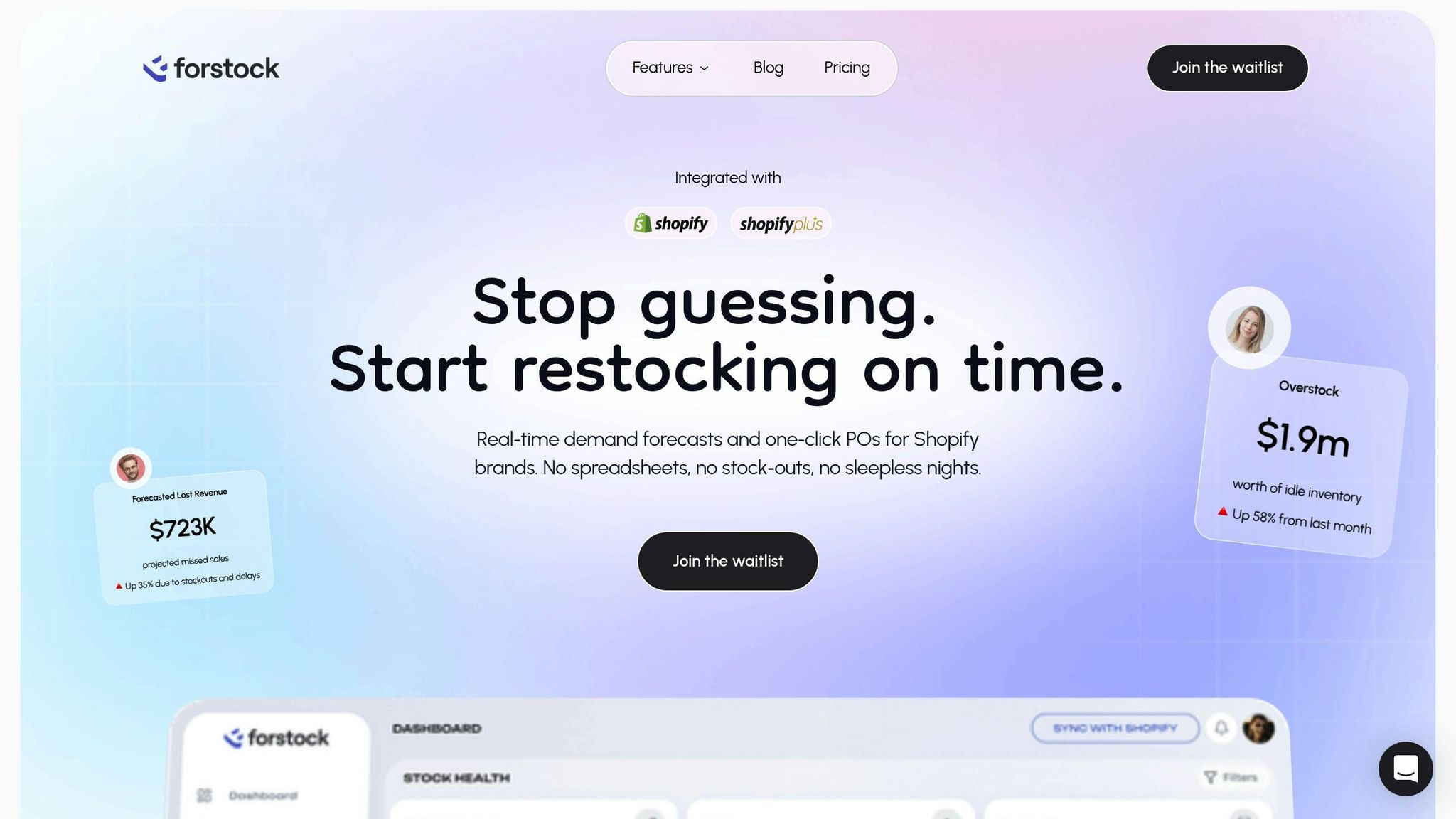
Before you get started, make sure your Shopify locations are properly set up. Go to Shopify Admin > Settings > Locations and add the names and addresses for all your warehouses, retail stores, or 3PL partners you want to track.
Step 1: Connect Forstock to Your Shopify Store

Log into your Forstock dashboard and authorize the connection to your Shopify store. The platform will automatically import your products, variants, and current stock levels. To set your fulfillment priorities, navigate to Settings > Locations > Location Priority, then drag and drop your locations into the order you prefer.
Once your store is connected and synced, you can enable AI forecasting to streamline inventory management.
Step 2: Turn On AI Demand Forecasting
Activate Alfred AI from the Forstock dashboard. This AI assistant uses real-time sales data and supplier lead times to predict which products need reordering and when. The system continuously learns from new data, improving its accuracy over time. Businesses often rely on AI to fine-tune inventory management.
"The AI forecast actually makes sense for my business. It feels like having a supply chain manager on my team." - Sophie, E-commerce Manager
Alfred AI provides SKU-specific forecasts tailored to each location. For example, if one store consistently sells more of a particular item, the system adjusts its predictions for that region. You can also manually override forecasts if external factors - like port closures or sudden regulations - aren’t yet reflected in the data.
Accurate forecasting is key to ensuring seamless automatic stock updates in the next step.
Step 3: Set Up Automatic Stock Updates
Enable real-time monitoring of sales and lead times to avoid stockouts. When inventory reaches the optimal reorder point, Forstock generates purchase order suggestions for you. Approve these with a single click, and once the items are received, the platform syncs updated stock levels back to Shopify.
Liam, an Operations Director, shared that Forstock helped reduce manual inventory tasks by 60%. The platform simplifies inventory management by replacing spreadsheets with a centralized system.
After automating stock updates, regularly monitor the system to make adjustments as needed.
Step 4: Monitor Performance and Adjust Settings
Use the Forstock dashboard to keep an eye on inventory health, turnover rates, and stock value across all your locations. The platform also offers real-time insights into supplier performance and open purchase orders. Key metrics like Mean Absolute Percentage Error (MAPE) help you track forecast accuracy, while Forecast Value-Added (FVA) shows how much AI adjustments improve predictions.
If you notice any discrepancies or want to tweak your settings, Alfred AI provides instant recommendations to help you make faster decisions. The system is flexible enough to grow with your business, whether you’re managing a handful of SKUs or thousands.
As Matt, a Solo Founder, put it:
"I thought inventory tools were only for big companies, but Forstock proved me wrong. It is user-friendly, plugs right into Shopify, and makes me feel in control."
sbb-itb-f0fc809
Why Forstock Works for Multi-Location Inventory Management
Forstock leverages AI-powered syncing and forecasting to deliver clear, measurable benefits for managing inventory across multiple locations.
Improved Accuracy and Reduced Manual Effort
Say goodbye to the headaches of spreadsheet errors. Forstock automatically syncs listings, orders, and inventory across your Shopify catalog in real time. Its AI-driven alerts notify you before stockouts happen, giving you the chance to reorder before it’s too late. Brands using Forstock have reported cutting down on manual inventory tasks significantly, freeing up valuable time to focus on growing their business instead of juggling numbers.
Simplified Scaling for Growing Businesses
When your business adds new locations, Forstock grows right alongside you. Its centralized Inventory Command Center offers a clear snapshot of your inventory health, turnover rates, and supplier performance, making it easier to expand without needing to hire additional staff. As Inventory Manager Emily shared, "I open the dashboard in the morning and instantly know what needs reordering, what is overstocked, and what to focus on." Features like one-click purchase orders and automated stock adjustments make scaling less stressful and more efficient. These tools not only simplify operations but also lay the groundwork for smarter, data-driven strategies as you expand.
Smarter Decisions Backed by Data
Forstock’s Alfred AI turns complex inventory data into actionable insights. It provides real-time SKU-level forecasts based on sales trends and supplier lead times, helping you stay ahead of demand. The platform’s analytics identify overstocked items, highlight products at risk of running out, and help you build a detailed 12-month demand plan. This approach has been shown to reduce forecast errors by 20–50%, lower stockouts by up to 18%, and increase revenue by 3–7% in just a few months.
Conclusion
AI is changing the game for Shopify brands managing inventory across multiple locations. Gone are the days of juggling spreadsheets and dealing with constant stockouts. Now, merchants can leverage real-time synchronization and predictive forecasting. These AI-powered tools not only improve accuracy over outdated methods but also cut inventory carrying costs by an impressive 20–30%.
Forstock takes these advancements to the next level. By integrating AI into your Shopify inventory management, it simplifies the process with features like automated purchase orders, real-time alerts, and a centralized dashboard. Managing inventory no longer takes hours - it’s a matter of minutes. As Sophie, an E-commerce Manager, explains:
"Before Forstock, I was literally living in spreadsheets... Since switching, I haven't had a single stockout, and I don't overorder anymore. The AI forecast actually makes sense for my business."
With Forstock, you can avoid stockouts, minimize excess inventory, and improve cash flow. Whether you’re handling two warehouses or ten retail locations, the platform grows with your business - no need for additional staff.
Stop relying on guesswork and start making confident decisions. Forstock provides real-time inventory visibility across all your locations. Try it today with a 14-day free trial for $39/month. Gain access to AI forecasting, automated reordering, and supplier management. Connect your Shopify store now and take full control of your inventory.
FAQs
How does AI help lower inventory costs by up to 30%?
AI plays a key role in cutting inventory costs by providing accurate demand forecasts. This helps businesses maintain optimal stock levels, reducing the chances of overstocking or running out of products. As a result, companies can lower storage fees, holding costs, and waste.
AI-powered tools also enable businesses to respond quickly to shifts in sales trends, lead times, and seasonal demand. By making smarter purchasing decisions, companies can improve cash flow and avoid tying up capital in unnecessary inventory. This approach can lead to savings of 20-30% on carrying costs.
How does AI help prevent stockouts across multiple locations?
AI plays a key role in avoiding stockouts by analyzing sales trends, demand patterns, and supplier lead times to generate precise, real-time inventory forecasts. These forecasts adjust dynamically to account for changing market trends and seasonal fluctuations, helping ensure you have the right products in the right places at the right time.
With automated inventory tracking and predictive insights, AI minimizes the chances of running out of high-demand items, even in multi-location operations. This not only streamlines your processes but also keeps customers happy by ensuring their favorite products are always in stock.
How does AI achieve 95% accuracy in demand forecasting for inventory management?
AI has reached an impressive 95% accuracy in demand forecasting by processing massive amounts of sales data. It spots patterns in trends, seasonality, and external factors like market changes. Even better, machine learning allows it to adjust over time, refining its predictions as new data comes in.
With these insights, businesses can make smarter purchasing decisions, cut down on stockouts, and prevent overstocking. This not only keeps inventory levels in sync with actual demand but also saves time, boosts cash flow, and ensures customers get what they need when they need it.


.png)
.png)
.png)
.svg)