

.png)
.png)
When your inventory data isn’t updated in real time, you risk overselling, stockouts, and operational delays that frustrate customers and hurt your bottom line. Real-time stock synchronization ensures accurate inventory updates across all sales channels - whether online or in-store - eliminating manual errors and saving time. For example, businesses using automated systems save over 10 hours per month and reduce costly mistakes caused by outdated data.
Key takeaways:
- Overselling and stockouts damage customer trust - 70% of online shoppers will switch to competitors if an item is unavailable.
- Manual updates waste time and lead to errors, with U.S. retailers averaging only 65% inventory accuracy.
- Real-time sync uses APIs to instantly update stock levels across platforms like Shopify, Amazon, and POS systems, ensuring smooth operations.
Tools like Forstock simplify inventory management with features like AI-powered demand forecasting, automated purchase orders, and centralized analytics. Businesses using these systems cut manual tasks by 60% and improve order accuracy, helping them focus on growth instead of fixing errors.
Example: Bared Footwear unified their inventory in January 2025, enabling simultaneous online and in-store promotions without overselling. Similarly, Danish retailer TeSelskabet increased sales by 25% after implementing real-time sync.
Don’t let outdated stock data disrupt your business. Real-time synchronization helps you maintain accurate inventory, reduce downtime, and improve customer satisfaction.
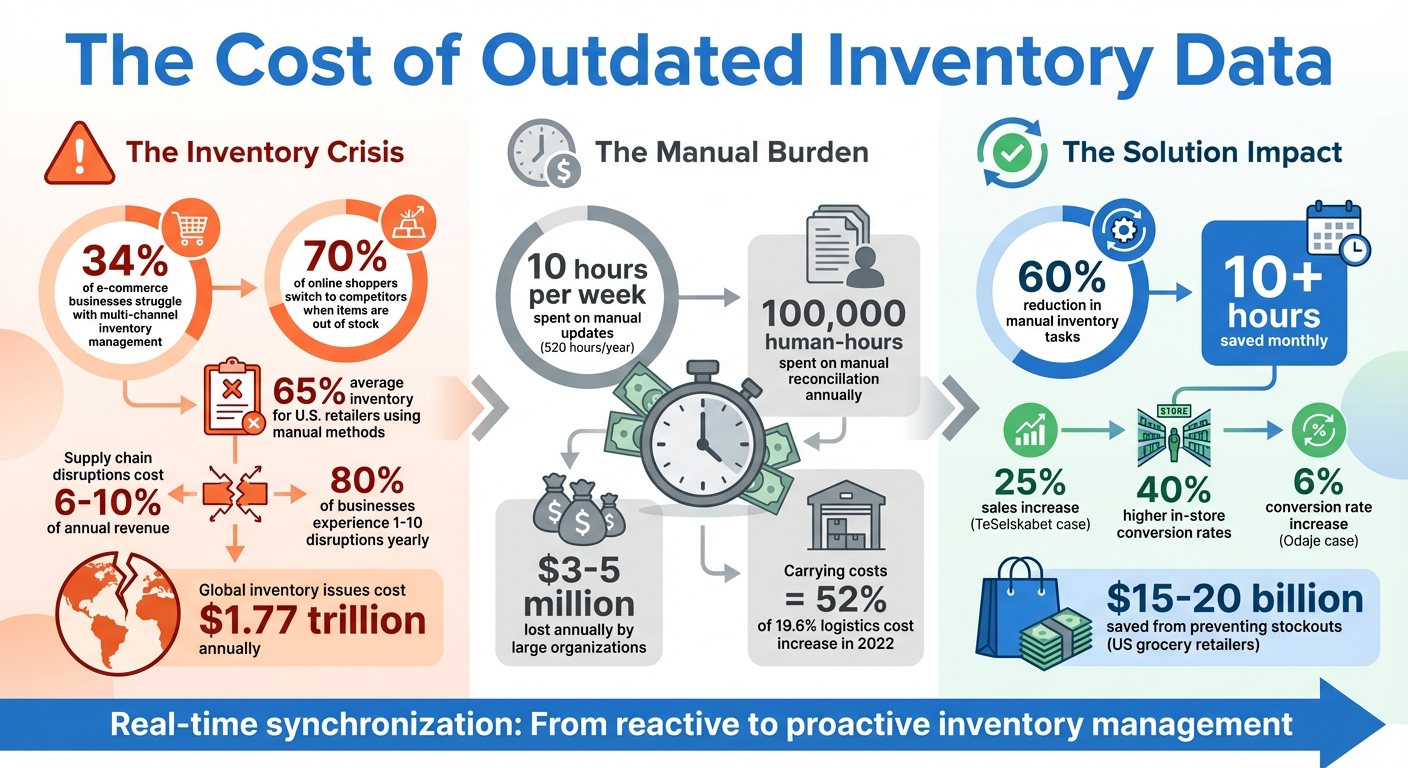
Real-Time Stock Sync Impact: Key Statistics on Inventory Accuracy and Business Costs
Real-Time Multi-Channel Inventory Sync Across ERP, Shopify, Amazon & More | APPSeCONNECT Demo
The Problem: Downtime from Outdated Stock Data
Outdated inventory data can bring operations to a grinding halt. A staggering 34% of e-commerce businesses face challenges managing inventory across multiple sales channels, often leading to mismatched stock levels. Supply chain disruptions alone can eat away 6–10% of annual revenue, with 80% of businesses experiencing between one and ten such disruptions in a year. When inventory systems fail to sync, it opens the door to overselling, manual errors, and delays that ripple across the entire operation.
Overselling and Stockouts
Picture this: a customer purchases the last pair of sneakers from your Amazon store, but your Shopify system hasn’t caught up. It still shows the sneakers as available. Meanwhile, another customer places an order through your website. Now you’ve oversold a product you don’t actually have. It’s not just a logistical headache - 34% of B2B buyers will lose confidence in a seller after encountering inventory issues, and nearly 70% of online shoppers will head straight to a competitor if they find an item out of stock.
During high-demand periods, some brands have had to resort to drastic measures to manage these issues. On the flip side, you might have products gathering dust in a physical store while your online shop incorrectly displays them as "out of stock", highlighting poor inventory allocation. Both scenarios damage customer trust and can hurt your bottom line.
Manual Inventory Updates
Manually updating inventory across platforms is a recipe for errors. Imagine having to log into Shopify Admin, navigate to Products > Inventory, and manually adjust stock every time a sale happens on Amazon or eBay. This tedious process invites typos, miscounts, and missed updates. Take Kimaï, a jewelry brand operating three Shopify stores. Before switching to an automated system, they spent 10 hours a week on manual inventory updates - adding up to a staggering 520 hours a year.
Even worse, manual adjustments can disrupt automated systems, leading to costly fixes and urgent troubleshooting. For U.S. retailers relying on manual or fragmented inventory tracking, accuracy drops to just 65%. Large organizations can lose between $3 million and $5 million annually, with manual reconciliation eating up 100,000 human-hours. That’s a massive drain on both time and resources.
Operational Delays
When stock data isn’t accurate, it throws a wrench into your entire workflow. Warehouse teams waste time searching for items that aren’t physically available or processing orders based on "ghost inventory" that exists only in the system. Meanwhile, marketing teams might pour money into ads promoting products that are actually out of stock, eroding customer trust and wasting budgets.
In cases where local warehouses appear stocked but are actually empty, businesses are forced into emergency fixes - like express shipping from distant locations or frequent, small orders. These quick fixes chip away at profit margins and amplify operational downtime. French footwear brand Odaje faced these challenges firsthand, struggling to manage disconnected data across 16 physical stores and an online shop. After adopting a unified, real-time inventory system, they saw a 6% increase in conversion rates.
Ignoring these issues means allowing outdated data to create bottlenecks that disrupt coordination across your business - from marketing to warehousing. The result? Missed opportunities, frustrated customers, and unnecessary costs.
The Solution: Real-Time Stock Synchronization
Real-time stock synchronization bridges the gap between your physical inventory and what your systems display. Every sale, return, or restock is immediately reflected across all your sales channels. For instance, if a customer purchases an item on Amazon at 2:00 p.m., your Shopify store, physical POS, and warehouse management system are updated within seconds. This instant syncing ensures that inventory data is always accurate, enabling smooth operations across all platforms.
How Real-Time Sync Works
At the heart of real-time synchronization is API integration, which enables seamless communication between platforms. APIs act as messengers, connecting systems like Shopify, Amazon, ERPs, warehouse management systems, and POS terminals. When a transaction happens, the API sends a signal to your centralized system, which updates stock levels across every linked platform. For example, if a customer places an order on your website, the system automatically reserves that inventory before the fulfillment process begins. Additionally, IoT sensors play a role by ensuring that digital records align with actual stock levels.
Unified Stock Visibility
Real-time syncing gives you a single, consolidated view of your entire inventory. Instead of juggling multiple dashboards or spreadsheets, you can access unified data from all warehouses, third-party logistics providers, and retail locations through one central interface. This streamlined visibility enhances order fulfillment, helping reduce costs and speed up deliveries.
A great example of this in action comes from Danish tea retailer TeSelskabet. In January 2025, they implemented Shopify POS and certified apps to synchronize product categories and bundles between their physical and online stores. This setup not only avoided overselling their intricate tea blends but also boosted total sales by 25%. The system provided detailed insights into product locations, empowering their marketing team to confidently promote items that were genuinely in stock.
Key Benefits of Using Forstock for Real-Time Stock Sync
Forstock takes the hassle out of inventory management by addressing common challenges like overselling and operational delays. With its native Shopify integration, the platform ensures your listings, orders, and stock levels sync instantly - no need for tedious manual updates or juggling spreadsheets. This seamless connection keeps your operations running smoothly and eliminates downtime.
AI-Powered Demand Forecasting
Forstock's AI goes beyond tracking past sales - it predicts future needs. By analyzing real-time sales data, supplier lead times, and seasonal trends, it calculates exactly when and what to reorder. Instead of waiting for stockouts to happen, you get alerts before your inventory runs out. This proactive approach is a game-changer, especially when stockouts cost US grocery retailers $15–$20 billion annually, accounting for roughly 3% of total sales.
On the flip side, the platform also prevents overordering by flagging slow-moving SKUs in real time. This helps you avoid tying up cash in excess inventory. Considering that carrying costs made up 52% of the 19.6% increase in US logistics costs in 2022, this feature directly impacts your bottom line.
"Before Forstock, I was spending excessive time on spreadsheets. I spent hours each week updating stock levels and trying not to miss reorder points. Since switching, I haven't had a single stockout, and I don't overorder anymore."
- Sophie, E-commerce Manager
Automated Purchase Orders
Creating purchase orders manually can be a time sink. Forstock automates this process, generating POs instantly based on demand and reorder rules. Whether you need to create, split, or track purchase orders, the platform handles it in minutes. It also centralizes supplier management, letting you monitor lead times and assess supplier performance from one place.
"With Forstock, we can create POs in minutes, track supplier performance, and streamline supplier coordination."
- Daniel, Supply Chain Manager
The time savings are impressive. Businesses using Forstock have reported cutting manual inventory tasks by at least 60%, freeing up their teams to focus on growth rather than data entry. Plus, with real-time inventory management saving businesses an average of 10+ hours monthly, the efficiency gains are undeniable. Automation also reduces human error - a major advantage when inventory accuracy for mid-to-large retailers typically hovers around 70%.
Centralized Inventory Analytics
Forstock replaces scattered spreadsheets with a unified dashboard, giving you a clear view of your inventory's health. You can quickly check turnover rates, stock value, and which products are selling versus sitting idle. This real-time visibility empowers you to make informed decisions, whether it's reordering stock or addressing cash flow issues caused by stagnant inventory.
The platform also includes Alfred AI, an assistant designed to interpret your inventory data and offer actionable insights. Need advice on turnover rates or supplier performance? Just ask Alfred.
"I open the dashboard in the morning and instantly know what needs reordering, what is overstocked, and what to focus on. It is one of the few SaaS tools I would call essential for scaling."
- Emily, Inventory Manager
Here’s how Forstock helps keep your inventory in check and prevents downtime:
| Feature | How It Prevents Downtime |
|---|---|
| AI Alerts | Sends notifications before inventory runs out, avoiding unexpected stockouts |
| Lead Time Analysis | Accounts for shipping delays to ensure stock arrives on time |
| Real-Time Sales Sync | Updates availability instantly across all channels to avoid overselling |
| Alfred AI Suggestions | Provides data-driven reorder recommendations during high-demand periods |
sbb-itb-f0fc809
Steps to Implement Forstock for Real-Time Stock Synchronization
Forstock is designed to integrate seamlessly with Shopify, making it easy to set up and start syncing your inventory in real time. There's no need for complicated migrations or technical know-how - just a few simple steps, and you're ready to go.
Installing and Setting Up Forstock
To get started, connect Forstock directly to your Shopify store using the built-in plug-in. This connection ensures that your listings, orders, and inventory are automatically synced across your entire catalog, eliminating the need for manual data entry or exporting spreadsheets.
Once the connection is established, you’ll need to select your preferred inventory update method. You can either enable automatic updates for real-time synchronization as sales occur or opt for manual updates when new stock arrives - whichever suits your workflow best. For businesses managing a large catalog, Forstock also supports bulk item imports via CSV files. While setting up purchase orders, you can include freight and duties to ensure your dashboard reflects accurate landed costs.
"The automated PO creation saves us 10+ hours weekly. Setup was seamless - just 2 minutes!" - Alexander, Supply Chain Manager at FashionCo
To finalize the setup, configure your supplier inputs and reorder rules, completing the synchronization process.
Setting Up Suppliers and Reorder Rules
Enter detailed supplier information into the platform, including lead times for each vendor. Forstock uses these lead times along with real-time sales data to calculate when you need to restock. By configuring reorder points based on sales velocity and supplier reliability, the system continuously monitors stock levels. When inventory falls below your set thresholds, it automatically generates purchase orders, saving you time and reducing the risk of stockouts.
Fine-tuning supplier details and reorder triggers also helps minimize downtime and keeps your operations running smoothly. Additionally, Forstock centralizes supplier communication and tracks performance metrics, making it easier to manage purchase orders and forecast demand.
"We were juggling dozens of suppliers and purchase orders every month... With Forstock, we can create POs in minutes, track supplier performance, and forecast demand without the guesswork." - Daniel, Supply Chain Manager
Monitoring Stock Levels in Real Time
The Forstock dashboard acts as your operational hub, giving you a clear view of your inventory status every time you log in. At a glance, you’ll see what needs reordering, which items are overstocked, and where your attention is most needed. The dashboard also features a performance leaderboard, showcasing your top 5 products by units sold, total value, and profit. You can filter insights by location, category, or date range to identify inefficiencies or missed opportunities.
With real-time tracking, the dashboard provides key metrics like inventory health, turnover rates, and total stock value across all your Shopify channels. For added support, Alfred AI is available to offer guidance on reorder decisions or supplier performance, eliminating the need to dig through complex spreadsheets. This centralized system aligns your sales, purchasing, and finance teams, reducing miscommunication and preventing costly downtime. By keeping everything in sync, you can maintain smooth operations and stay ahead of potential disruptions.
Measuring Success: Metrics for Downtime Reduction
Once you’ve implemented real-time synchronization, it’s essential to monitor specific metrics to evaluate its effectiveness in reducing downtime and improving overall operations. Real-time stock sync not only minimizes downtime but also delivers precise data to assess how well your system is performing. Focus on metrics like order accuracy, stock levels, and labor savings to measure success.
Order Fulfillment Accuracy
Order fulfillment accuracy reflects the percentage of orders shipped without any errors. To calculate it, use the formula: (correct orders ÷ total orders) × 100. With real-time synchronization in place, this percentage should improve since your team will rely on accurate, up-to-date stock information rather than outdated spreadsheets.
Consider this: U.S. retailers typically achieve only about 65% inventory accuracy. This means nearly one-third of their stock records are unreliable, leading to fulfillment mistakes and wasted labor. Monitoring your perfect order rate - the percentage of orders completed without any issues - offers a clear snapshot of your operational efficiency.
Stockout and Overstock Rates
The stockout rate measures how often items are unavailable when customers attempt to purchase them. A high stockout rate can significantly impact revenue - nearly 70% of online shoppers will switch to a competitor if an item is unavailable. On the other hand, low sell-through rates signal excess inventory, tying up capital in products that aren’t moving.
To understand the financial impact of inventory gaps, calculate the lost sales ratio: (lost sales ÷ total potential sales) × 100. Additionally, tracking days sales in inventory (DSI) can help measure how quickly your inventory is being sold. A lower DSI indicates better cash flow. Tools like Forstock’s AI-powered forecasting can refine these metrics by predicting demand trends and automatically adjusting reorder points.
Time Savings from Automation
Unit labor cost is a useful metric to measure efficiency, calculated by dividing total labor costs by the number of units processed. Automating tasks like purchase orders and inventory updates can save over 10 hours each month by eliminating manual data entry. It also prevents labor-intensive reconciliations, which can consume up to 100,000 human-hours annually.
Keep an eye on metrics such as time-to-receive and putaway time to identify inefficiencies. With systems that automatically generate purchase orders based on real-time sales trends and supplier lead times, these processes can be significantly streamlined. This allows your team to focus on growth-oriented activities rather than administrative tasks.
Conclusion
Keeping your stock updated in real-time is a game-changer for avoiding downtime and staying ahead of the competition. When your inventory syncs across all sales channels, you eliminate overselling and stockouts - the kind of mistakes that can send customers straight to your competitors. To put this into perspective, global inventory issues cost businesses a staggering $1.77 trillion every year.
Shifting from reactive to proactive inventory management can completely overhaul how Shopify stores operate. Instead of wasting hours juggling spreadsheets or rushing to place last-minute orders, you gain the clarity needed to make smarter, data-driven decisions. Retailers who use integrated inventory systems have reported up to 40% higher in-store conversion rates. Plus, automating workflows cuts down on manual tasks, saving valuable time. Forstock's platform delivers all of this effortlessly.
With Forstock, you get AI-powered forecasting, automated purchase orders, and centralized analytics - all in one place. By analyzing sales trends and lead times, the platform helps ensure you’re always ordering the right products at the right time. As Liam, an Operations Director, shared:
"We have cut manual inventory tasks by at least 60%".
Real-time synchronization protects businesses - whether small or multi-channel - from the disruptions that affected 80% of companies in 2024. And with warehouse rents climbing to $9.72 per square foot in 2023, a 20.6% increase from the previous year, overstocking is more costly than ever. Accurate forecasting isn’t just helpful - it’s critical for maintaining healthy cash flow.
Say goodbye to inventory downtime and focus on scaling your business. Try Forstock free for 14 days - plans start at just $39 per month.
FAQs
How does real-time stock syncing help prevent overselling and running out of stock?
Real-time stock syncing keeps your inventory updated across all your sales channels the moment a purchase is made. This automatic adjustment helps eliminate the risk of overselling by ensuring every channel reflects the correct stock levels instantly.
On top of that, low-stock alerts can notify you when it’s time to reorder, making it easier to avoid running out of popular items. With this kind of synchronization, you’ll always have accurate inventory data at your fingertips, allowing you to meet customer demand without hiccups.
How does AI-powered demand forecasting improve inventory management?
AI-driven demand forecasting takes the guesswork out of inventory management. By reducing stockouts and preventing overstock, it ensures you maintain just the right amount of inventory at all times. Plus, it can automate up to 60% of manual reordering tasks, saving time, cutting down on errors, and improving cash flow.
With the ability to analyze sales patterns, seasonal shifts, and lead times, AI creates precise 12-month inventory plans. This can help businesses reduce inventory levels by as much as 30% while simplifying logistics. By relying on this data-focused method, you can make smarter buying decisions and concentrate on growing your business with peace of mind.
How can businesses evaluate the benefits of real-time stock synchronization?
To evaluate how well real-time stock synchronization is working, focus on a few key metrics: inventory accuracy, stockout rates, and oversell rates. When these numbers improve, it shows that your stock levels are aligning better with customer demand.
You should also keep an eye on order fulfillment speed, inventory turnover, and carrying costs. If these metrics are trending in the right direction, it usually means your operations are running more smoothly, with less waste. On top of that, pay attention to customer feedback and satisfaction scores to understand how these changes are influencing the shopping experience. Together, these measurements give you a solid understanding of how real-time syncing boosts efficiency and helps your business grow.



.png)
.png)
.png)
.svg)