

.png)
.png)
Stockouts during peak seasons can cost retailers billions in lost revenue. Customers won't wait for restocks - they'll turn to competitors, damaging both your sales and long-term customer trust. Common issues like static reorder points and unprepared inventory systems make the problem worse.
Here’s how to prevent stockouts during high-demand periods:
- Adjust reorder points: Base them on peak-specific data, not annual averages.
- Recalculate safety stock: Factor in higher sales and longer lead times during busy seasons.
- Plan for demand spikes: Use historical trends and real-time data to anticipate surges.
- Utilize inventory tools: Automate forecasting and reorder processes with platforms like Forstock.
Holiday Inventory Prep to Help Avoid Stockouts and Overstocking | Secret Life of Inventory
Why Seasonal Peaks Create Inventory Problems
Seasonal peaks wreak havoc on inventory systems, especially during high-demand events like Black Friday, Cyber Monday, and the holiday season. Demand during these periods can skyrocket to as much as four times the usual levels. This sudden surge introduces a host of challenges: unpredictable demand patterns, longer supplier lead times, and the limitations of relying on historical averages. The result? Supply chains struggle to keep up, and businesses are left scrambling.
Demand becomes especially volatile when external factors like weather changes, viral TikTok trends, influencer promotions, or unexpected competitor moves cause orders to spike overnight. Even a product that typically sells steadily throughout the year can sell out in hours due to a single viral post.
On the supply side, things don’t get any easier. Suppliers often face bottlenecks during peak periods, which stretch manufacturing and delivery timelines. In 2024, nearly 90% of companies reported supply chain disruptions, with average response times extending to around two weeks. When sales rise sharply and lead times grow longer, static inventory systems simply can’t keep up.
What Stockouts Cost Shopify Brands

These challenges don’t just create operational headaches - they hit profits hard. Stockouts during peak periods aren’t just about one missed sale. When a customer can’t find a product they want, they’re likely to turn to a competitor rather than wait. This not only results in lost revenue but can also reduce customer lifetime value. A poor experience during a critical shopping period can discourage repeat purchases and word-of-mouth referrals.
The stakes are even higher during peak sales events. Falling short on inventory during these times - when sales volumes and profit margins are at their highest - forces brands to take expensive emergency actions. Expedited shipping and last-minute rush orders may help restock shelves, but they also eat into profit margins. On top of that, there’s the risk of overcorrecting. Ordering too much to make up for stockouts can leave businesses with excess inventory when demand drops, tying up capital unnecessarily.
Why Fixed Reorder Points Fail
Fixed reorder points are built on the assumption that demand remains steady, triggering restocks when inventory falls below a set level. While this method might work during normal times, it’s a recipe for disaster during seasonal peaks.
The problem lies in how these systems calculate demand. Fixed reorder points often rely on average monthly sales across the year. For instance, if your average monthly sales are 1,000 units but December demand jumps to 4,000 units, a reorder point based on the annual average will activate far too late - causing you to miss critical sales opportunities.
Emily Rodriguez from StockPerfect highlights this flaw:
"Using average monthly demand across the year fails to account for dramatic seasonal spikes".
Additionally, fixed safety stock levels, designed for stable demand, fall short during unexpected surges. Without the ability to adapt, businesses risk running out of stock when demand is at its peak. And once the rush is over, they might find themselves stuck with excess inventory. These limitations make it clear: during seasonal peaks, inventory systems need to be dynamic and responsive, not rigid and static.
How to Adjust Reorder Points for Seasonal Demand
When seasonal demand spikes, adjusting reorder points becomes crucial. This process involves recalculating using peak-specific data, factoring in longer lead times, and increasing safety stock to accommodate higher demand. Using annual averages during peak seasons can lead to miscalculations, so it's important to replace them with data that reflects seasonal realities. Below, we’ll break down the formula adjustments and provide examples to clarify how this works.
The Reorder Point Formula
The reorder point is your signal to restock inventory before running out. The formula is:
(Average Daily Sales × Lead Time in Days) + Safety Stock.
Each part of the formula serves a purpose:
- Average daily sales measure how quickly inventory is sold.
- Lead time accounts for the days between placing an order and receiving the stock.
- Safety stock acts as a cushion against unexpected demand increases or supplier delays.
Here’s a practical example: Imagine a shop sells 4 units daily, has a lead time of 35 days, and keeps 20 units as safety stock. The reorder point would be:
(4 units/day × 35 days) + 20 units = 160 units.
When inventory hits 160 units, it’s time to reorder.
Now, let’s look at a furniture retailer selling 5 chairs daily, with the same 35-day lead time and 15 chairs as safety stock. Their reorder point would be:
(5 × 35) + 15 = 190 units.
Once their stock drops to 190 chairs, a new order should be placed.
Seasonal Factors That Affect Reorder Points
Seasonal demand introduces unique challenges that require adjusting the core formula. During these periods:
- Daily demand increases as sales pick up speed.
- Lead times may stretch due to supplier delays, port congestion, or shipping backlogs.
- Safety stock needs to grow to handle unpredictable demand spikes.
"Reorder points in inventory management are like a fuel gauge in a car, alerting you when it's time to refill... During peak seasons, sales may surge, meaning reorder points should be adjusted higher to avoid stockouts".
This analogy, shared by Andres Estrada, Senior NetSuite Technical Lead, highlights the importance of adapting reorder points dynamically.
Another factor to consider is service level goals. During busy seasons, businesses often aim for higher fulfillment rates - raising their target from 90% to 95%, for example. A 95% service level corresponds to a service level factor of 1.65 in safety stock calculations, which directly increases the reorder point.
Here’s a quick overview of seasonal adjustments:
| Variable | Seasonal Adjustment Action | Impact of Ignoring Adjustment |
|---|---|---|
| Average Daily Demand | Increase to reflect peak sales velocity. | Stockouts may occur before the next shipment arrives. |
| Lead Time | Extend to account for supplier delays. | Inventory may arrive too late for peak demand. |
| Safety Stock | Raise to cover volatile peak demand. | Missed opportunities during unexpected surges. |
| Service Level | Increase for high-priority items. | Lost revenue and reduced customer trust. |
Failing to adjust for these variables can lead to late reorder triggers, forcing businesses to rely on costly emergency shipments or risk losing sales altogether. To stay ahead, recalculate reorder points every 30, 60, or 90 days during peak seasons. If you’re planning promotions or marketing campaigns, update your demand forecasts in advance. This proactive approach ensures your inventory levels align with market conditions and customer expectations.
sbb-itb-f0fc809
How to Recalculate Reorder Points for Peak Seasons

3-Step Process to Recalculate Reorder Points for Peak Seasonal Demand
Adjusting reorder points for peak seasons requires using data from your busiest times instead of relying on annual averages. By replacing generalized figures with specific data that reflects your inventory's movement during demand surges, you can better prepare for seasonal fluctuations. Here’s how to make these adjustments in three straightforward steps.
Step 1: Analyze Past Sales Data
Start by diving into your historical sales records. Look at data from at least the past two years to spot patterns that repeat during peak seasons. For instance, if your December sales consistently reach 250% of your average monthly sales, this gives you a seasonal index of 2.5.
When forecasting for upcoming seasons, use comparable periods as benchmarks. For example, to plan for Q4 2026, review sales data from Q4 2024 and Q4 2025. Focus on key metrics like peak sales days, average order volumes during those days, and your highest single-day sales. Also, identify factors driving demand - whether it’s weather, school schedules, or marketing efforts.
To pinpoint peak daily sales, divide total seasonal sales by the number of peak days. This approach moves beyond annual averages, giving you a clearer picture of how inventory flows during high-demand periods.
Step 2: Update Safety Stock for Peak Times
Traditional safety stock calculations often fall short during peak seasons. Instead, use peak-specific data to recalculate safety stock based on maximum daily sales and lead times from prior busy periods. Apply the formula:
(Max Daily Sales during peak × Max Lead Time during peak) – (Average Daily Sales during peak × Average Lead Time during peak).
Keep in mind that supplier lead times may stretch during peak periods due to production backlogs, port delays, or holiday shipping congestion. When estimating maximum lead times, include production time, delivery time, and extra days to account for potential delays.
For businesses with seasonal demand, maintain minimum inventory at about 70% of the maximum inventory level used during the busiest times. This ensures you can sustain operations between peaks without overcommitting capital during slower months.
Once you’ve recalculated safety stock, test these adjustments under different scenarios to evaluate their effectiveness.
Step 3: Simulate Different Demand Scenarios
Testing various demand conditions can help fine-tune your reorder points. Compare scenarios like these:
| Scenario Type | Impact on ROP Calculation | Recommended Action |
|---|---|---|
| Normal Demand | Relies on standard daily sales and lead times. | Maintain standard safety stock (e.g., 10-15%). |
| Peak Season (e.g., BFCM) | High sales velocity and possible delays. | Increase safety stock; apply seasonal index (e.g., 2.0x). |
| Viral Trend/Promotion | Sudden, extreme surge in sales. | Set "At Risk" alerts; prepare for emergency air freight. |
| Supply Chain Delay | Longer lead times (e.g., 14 to 30 days). | Update ROP immediately to trigger earlier orders. |
A staggered ordering strategy can also help manage risk. Start with 60–70% of your inventory early in the season, place another 20–30% mid-season, and reserve 10–15% for final adjustments based on how the season unfolds. This flexible approach allows you to adapt quickly to changing conditions while minimizing overstock or shortages.
How Forstock Handles Seasonal Inventory
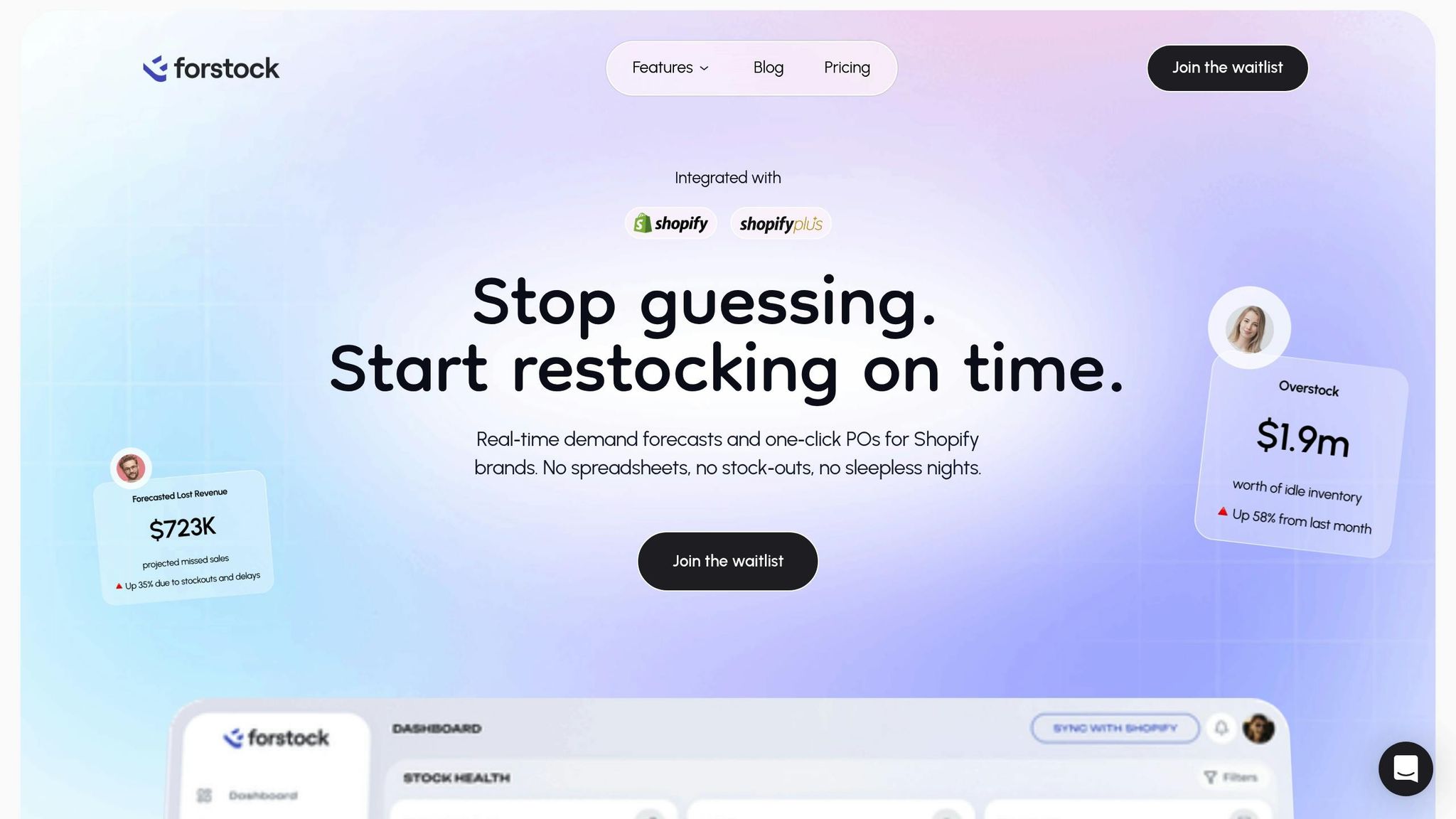
Managing seasonal inventory can feel like a juggling act, but Forstock simplifies the process for Shopify brands with its automated, data-driven tools. By using real-time Shopify data, it adjusts forecasts and streamlines demand planning, making seasonal inventory management more manageable.
Here’s how Forstock helps merchants tackle seasonal inventory challenges:
AI Demand Forecasting
Forstock leverages machine learning to identify seasonal trends. By analyzing historical Shopify data, it pinpoints demand triggers like weather changes or holiday surges. The system then calculates seasonal indexes (e.g., a 250% increase in demand) to refine future projections with an impressive 95% accuracy rate. It also determines the right safety stock levels, balancing demand fluctuations with service goals, so merchants stay prepared.
Automated Purchase Orders
Forstock’s purchase order tools take the guesswork out of reordering. They factor in supplier lead times and seasonal constraints, automatically triggering reorders based on real-time sales data. Plus, early warnings ensure merchants can work with suppliers to avoid stockouts. This proactive system has been shown to cut stockouts by up to 65%.
Shopify Inventory Dashboard
Forstock’s Shopify integration includes a real-time inventory dashboard that keeps merchants in the loop. Stock levels across all channels are updated instantly, allowing quick responses to changes in demand. Merchants can track performance across warehouses and retail locations, ensuring products are available where they’re needed most. The dashboard also offers analytics, reorder suggestions, purchase order tracking, and supplier management. Plans start at $39 per month, with a 14-day free trial available.
Conclusion
Seasonal demand spikes don’t have to mean empty shelves or overflowing stockrooms. By recalibrating reorder points with seasonal data instead of relying on annual averages, you can sidestep costly revenue losses and keep your inventory in check.
Top-performing Shopify brands stay ahead by fine-tuning their inventory strategies with detailed seasonal insights and smarter forecasting methods.
Modern tools like Forstock take the guesswork out of inventory management. With AI-powered demand forecasting that boasts 95% accuracy, it dynamically adjusts reorder points based on real-time sales trends and even automates purchase orders to prevent stockouts. Starting at just $39 per month - with a 14-day free trial - this solution makes advanced inventory management accessible for businesses of all sizes.
Get ahead of the next seasonal surge: review your past sales data, run demand simulations, and automate your processes. Brands that prepare in advance consistently meet customer needs without overloading their warehouses or straining their budgets.
FAQs
How can I adjust reorder points to handle seasonal demand spikes?
To effectively manage seasonal demand spikes, start by diving into your historical sales data. Pinpoint periods when demand typically surges - like holidays or specific seasonal events - and use this information to fine-tune your reorder points. By accounting for increased sales velocity during these times, you can ensure your inventory levels are sufficient to meet customer demand without risking stockouts.
Leveraging demand forecasting tools can make this process much easier. For example, platforms like Forstock use AI-driven forecasting to analyze sales trends and automatically adjust reorder points. These tools take seasonality and variable lead times into account, saving you time and effort. Make it a habit to regularly review and update your reorder points as fresh seasonal data comes in, so you're always ready for the next peak in demand.
Why can fixed reorder points lead to stockouts during seasonal peaks?
Sudden spikes in demand during seasonal peaks can wreak havoc on fixed reorder points. They often leave businesses scrambling to meet customer orders, leading to inventory shortages that might tarnish your brand's reputation.
To avoid this, it’s crucial to adjust reorder points using real-time demand forecasting and sales trends. By leveraging tools that account for seasonality, you can keep your stock levels in sync with customer needs, reducing the chances of stockouts and ensuring smoother operations during high-demand periods.
How can Forstock help avoid stockouts during busy seasonal periods?
Forstock keeps you prepared for seasonal shifts by leveraging real-time demand forecasting. This feature helps predict sales trends, ensuring your inventory levels align perfectly with customer needs. It takes into account factors like lead times and seasonality, enabling you to make informed decisions and avoid those dreaded out-of-stock moments when demand peaks.
On top of that, Forstock streamlines your workflow by automating purchase orders and centralizing inventory management. The result? Smoother operations, consistently stocked shelves, satisfied customers, and more time for you to focus on scaling your business.



.png)
.png)
.png)
.svg)