

.png)
.png)
Managing inventory costs can be challenging, but collaborating with your suppliers can make a big difference. By using strategies like Vendor Managed Inventory (VMI), negotiating better terms, and implementing Just-In-Time (JIT) inventory, businesses can cut costs and improve efficiency. Here's a quick breakdown:
- Vendor Managed Inventory (VMI): Suppliers monitor and replenish your stock using real-time sales data, reducing overstock and storage costs.
- Volume Discounts: Negotiate better pricing by increasing order quantities, combining purchases across product lines, or forming purchasing groups.
- Just-In-Time (JIT): Align deliveries with actual demand to reduce holding costs and free up cash flow.
- Data Sharing: Share sales and demand forecasts with suppliers to improve planning and avoid stockouts.
- Automation Tools: Use platforms like Forstock to streamline purchase orders, forecasting, and supplier communication.
These strategies can lower holding costs by 15–25%, improve inventory turnover by 20–30%, and reduce stockouts by up to 50%. Start small by testing these methods with your top products and scale as you see results.

Impact of Vendor Collaboration on Inventory Costs and Performance Metrics
Vendor Managed Inventory (VMI) Explained | Types of VMI | How VMI Works with Examples | Pros & Cons
sbb-itb-f0fc809
Negotiating Volume Discounts and Bundled Orders
Reducing inventory costs often starts with lowering the price you pay per unit. Suppliers set Minimum Order Quantities (MOQs) to cover fixed production costs - things like labor, materials, and machinery setup - and to ensure each production run remains profitable. By committing to higher MOQs, businesses can secure lower per-unit prices and a steady supply. Many suppliers are open to adjusting terms for consistent, predictable orders, making this a win-win strategy. This approach also ties into using real-time supplier data to strike a balance between inventory levels and cash flow.
How Volume Discount Pricing Works
MOQs are based on factors like demand, holding costs, and the break-even point for production. When you use real-time sales data, you can often negotiate better terms, fostering stronger vendor relationships. For example, if you spend $1.2 million annually with a supplier, a 5% discount could save you $60,000. But savings like this need to be weighed against the potential downsides. Inventory holding costs usually range from 20% to 30% of the inventory's value each year. So, if you order 250 extra units at $18 each, you’re tying up $4,500 in cash and adding roughly $900 in yearly carrying costs.
To avoid locking up too much capital, consider negotiating staggered deliveries or signing a long-term contract. These options let you benefit from bulk discounts without overloading your inventory. If meeting high MOQs isn’t feasible, you can also agree to a slightly higher per-unit price on smaller batches, which helps cover setup costs while avoiding excess stock.
Combining Purchases Across Product Lines
You don’t always need to order massive quantities of a single product to qualify for volume discounts. By standardizing parts - like screws, fabrics, or electronic chips - across different product lines, you can increase your total purchase volume for shared components. This often allows you to negotiate discounts based on total spend rather than unit counts. For example, instead of ordering 1,000 units of one item, you might qualify for a discount by spending $2,000 across the supplier's entire catalog.
Another smart tactic is forming purchasing groups. In the healthcare sector, 88% of hospitals report saving money by joining Group Purchasing Organizations (GPOs), which pool their purchasing power to negotiate better prices. E-commerce businesses can adopt a similar approach by partnering with other companies to combine orders. This strategy boosts bargaining power without overstocking individual items, making it a great addition to other cost-saving measures covered in this guide.
Setting Up Just-In-Time (JIT) Inventory with Suppliers
Once you’ve locked in volume discounts, don’t let excess inventory tie up your cash. Just-In-Time (JIT) inventory flips the script on traditional stocking methods. Instead of stockpiling goods "just in case", JIT relies on smaller, more frequent shipments that match actual customer demand. The idea is to shorten lead times and reduce unpredictability, which means you can carry less safety stock and free up working capital for other priorities.
The backbone of JIT is digital integration. Tools like EDI, APIs, or supplier portals can automate purchase orders when inventory hits a pre-set threshold. For example, if your Shopify store sells 50 units of a product and stock dips below the reorder point, the system automatically generates a purchase order - no manual intervention needed.
JIT also demands tight logistics coordination. Work with suppliers to streamline transport routes, bundle shipments, or schedule cross-docking to cut down on delays. Some suppliers even offer guaranteed production slots for a small premium (3–5%), which can be well worth it to avoid stockouts during high-demand seasons. These strategies can trim lead times by 15–30% and significantly cut variability.
How JIT Reduces Inventory Costs
JIT offers a direct solution to the hefty 20–30% annual carrying costs that eat into margins. By holding less inventory, you save on warehouse fees, insurance, and the opportunity cost of immobilized capital. Plus, since lead time variability causes up to 70% of stockouts in supply chains with long lead times (30+ days), stabilizing delivery schedules allows for smaller safety stock reserves.
For example, cutting lead times from 42 to 25 days can reduce required safety stock by as much as 60%. This reduction frees up capital and slashes carrying costs. Additionally, aligning demand planning with suppliers can reduce stockouts by 30–50% and trim excess inventory costs by 20–40%.
Switching from batch ordering to daily replenishment also minimizes waste. Products with low inventory turnover (fewer than three cycles per year) often lose money due to storage costs and tied-up capital. By speeding up inventory turnover, JIT not only improves cash flow but also reduces the risk of obsolescence - especially important for industries like fashion, electronics, or seasonal goods.
Aligning Delivery Schedules with Demand
For JIT to work, your suppliers need to sync their production and delivery schedules with your actual sales. Start by sharing rolling forecasts for the next 8–12 weeks. This gives suppliers the lead time to secure raw materials and reserve production capacity before formal orders come in.
Set clear replenishment parameters with suppliers, such as minimum and maximum stock levels, reorder points, and safety stock requirements. The reorder point formula is simple:
(Average Daily Sales × Lead Time) + Safety Stock.
For instance, if you sell 20 units daily and your lead time is 10 days, your reorder point would be 200 units, plus a safety stock buffer to cover unexpected demand or delays.
Also, coordinate promotional schedules with your suppliers. Let them know about upcoming sales or flash events at least 2–3 weeks ahead. This prevents temporary demand spikes from being misinterpreted as long-term trends, which could inflate safety stock unnecessarily. For high-demand items, consider dual-sourcing - use a domestic or nearshore supplier for quick replenishment (5–14 day lead times) while waiting for lower-cost offshore shipments.
| Data Sharing Level | Method | Update Frequency | Best For |
|---|---|---|---|
| Basic | Automated CSV/Email | Daily | Pilot phase, small suppliers |
| Intermediate | API Integration | Every 4–8 hours | Established programs |
| Advanced | EDI Integration | Real-time | High-volume, multi-supplier setups |
Finally, keep a close eye on sync lag. Ensure warehouse inventory updates are reflected in your Shopify system within 30 minutes to avoid overselling. Partnering with third-party logistics (3PL) providers can boost inventory accuracy to 95–98%, compared to 75–85% with manual updates. Conduct weekly demand reviews to spot trends - like social media buzz or pricing changes - and adjust your plans before they lead to stockouts. This level of precision sets the foundation for stronger data sharing and better collaboration with suppliers.
Sharing Data and Analytics with Vendors
Once delivery schedules are aligned, the next step is sharing data with your suppliers. Providing suppliers with sales velocity data changes the game. Instead of reacting to orders, suppliers can plan shipments based on actual demand. This level of transparency helps avoid last-minute rush orders that disrupt production schedules and allows suppliers to secure raw materials well ahead of time. The result? Suppliers can act proactively rather than reactively.
It’s important to set boundaries when sharing data. Suppliers typically need information like SKU identifiers, current stock levels, average sales figures, and pending inbound inventory. However, customer details, profit margins, and channel splits should remain confidential. For smaller suppliers, automated CSV exports are an affordable option with minimal setup costs, while API integrations - costing between $2,000 and $10,000 - might be more suitable for larger, established partnerships. To keep things running smoothly, provide updates consistently: daily updates work for simpler setups, while real-time syncing is better for high-volume operations.
The benefits of sharing demand forecasts with suppliers are substantial. Brands often see stockouts decrease by 30–50%, excess inventory costs drop by 20–40%, and inventory turnover improve by 20–30% when suppliers have direct access to sales data.
Using Demand Forecasts to Guide Orders
Shared data becomes even more powerful when used to create rolling 90-day forecasts. These forecasts help suppliers reserve production slots and secure raw materials before prices rise. This approach also prevents the bullwhip effect, where a temporary sales spike is mistaken for a long-term demand increase.
It’s equally crucial to communicate planned flash sales or marketing campaigns to suppliers at least 2–3 weeks in advance. This ensures short-term promotions aren’t misinterpreted as ongoing demand, which could lead to overstocking. For high-performing SKUs - the top 20% that typically generate 80% of revenue - stricter data-sharing policies and tighter safety stock calculations can make a big difference. Sharing a reorder point formula - (Average daily sales × lead time in days) + safety stock - helps both you and your suppliers know exactly when to trigger shipments.
Working Together on Inventory Analytics
Collaborating on analytics tools creates a feedback loop that benefits both parties. Start by reviewing sales variance against forecasts on a weekly or monthly basis. If sales consistently deviate from predictions, dive into potential causes like social media trends, competitor stockouts, or pricing shifts.
Before sharing data, it’s essential to clean up anomalies. For example, exclude data from 72-hour flash sales or periods with high return rates, as these can distort true demand. Sharing leading indicators, such as market search trends or competitor import volumes, can also provide early warnings of demand shifts - up to 4–6 weeks before they show up in sales reports.
Initially, review shared analytics monthly for six months, then transition to quarterly check-ins. Track supplier performance metrics, such as on-time delivery rates and quality acceptance, and share these scorecards to promote accountability. These analytics can significantly improve coordination. In fact, collaborative forecasting has been shown to boost forecast accuracy by 15% and reduce excess inventory by 10–20%. In the end, sharing data isn’t just about transparency - it’s a way to gain a competitive edge.
Using Forstock to Improve Vendor Coordination
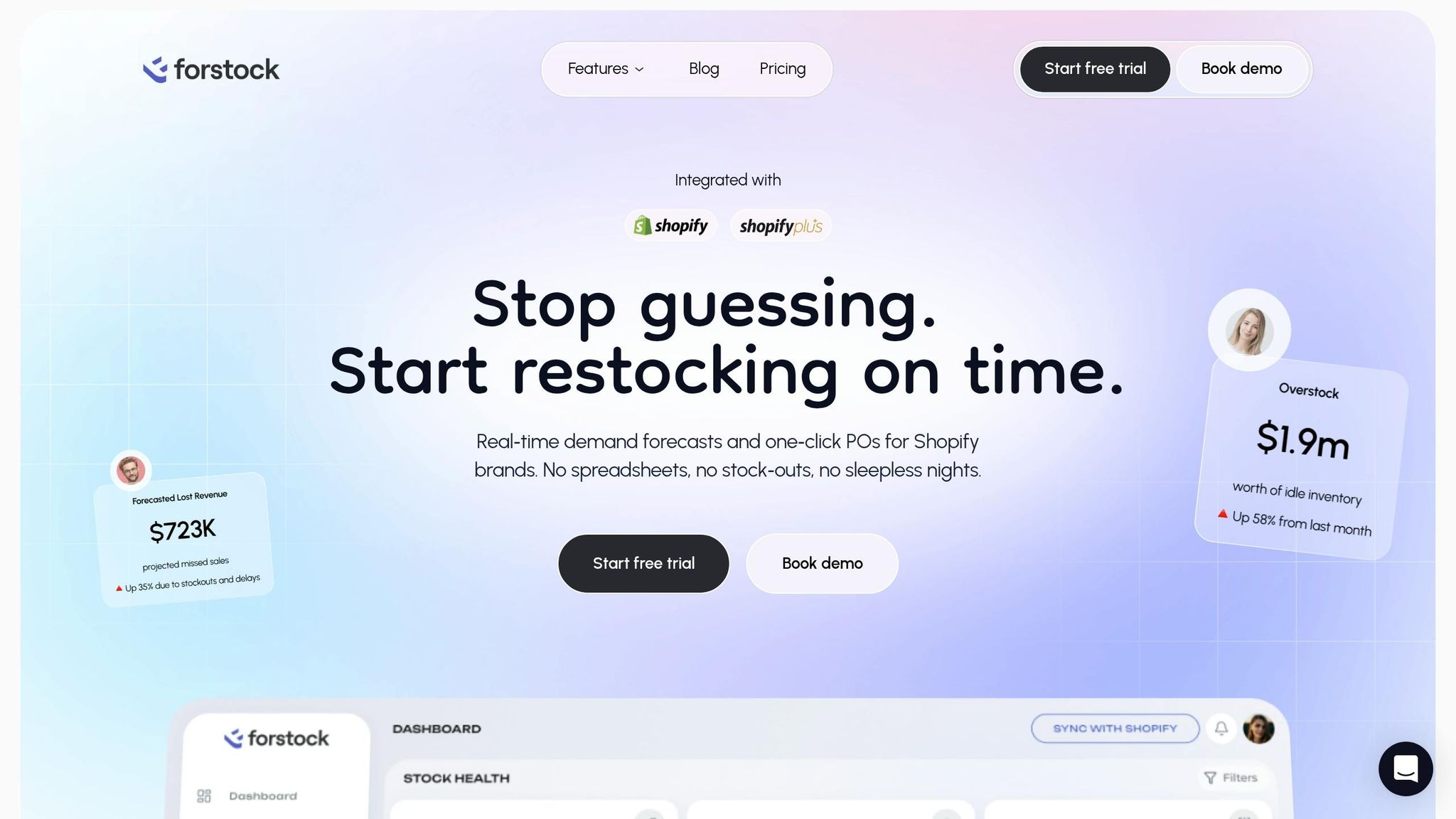
Forstock simplifies vendor coordination by automating key processes and centralizing inventory management and supplier relationships for Shopify brands. Through its unified dashboard, Forstock handles purchase orders, supplier communication, and inventory tracking, bridging the gap between demand forecasting and supplier management.
Alexander, a Supply Chain Manager at FashionCo, shared:
"The automated PO creation saves us 10+ hours weekly. Setup was seamless - just 2 minutes!"
Matt, Operations Lead at TechGear, highlighted:
"Forstock has been great. We're preventing stockouts that were costing us $50K monthly. The AI predictions are incredibly accurate."
Jason, Co-founder at HomeGoods, noted:
"We reduced excess inventory by 45% and freed up $150K in working capital."
These results showcase how automation can transform purchase order management and forecasting.
Automating Purchase Orders and Supplier Messages
Creating purchase orders manually can eat up time that could be spent on strategic tasks. Forstock's automated system generates orders in minutes using templates, filters, or CSV imports, factoring in landed costs like freight and duties. Its AI-powered Reorder Table pinpoints necessary reorders based on demand forecasts, helping avoid stockouts and overstocking. The dashboard tracks open orders, supplier statuses, and payment progress, while one-click receiving updates inventory levels and syncs with Shopify - even for partial shipments.
Liam, an Operations Director, emphasized:
"We have cut manual inventory tasks by at least 60%."
For maximum efficiency, you can upload bulk orders via CSV and include landed costs in the PO process to gain a complete expense overview. Regularly reviewing the Reorder Table ensures you stay on top of high-priority restocking needs, and the system automatically updates Shopify inventory as goods are received.
Making Better Purchasing Decisions with AI Forecasting
Forstock's AI uses Shopify data - like seasonality, trends, and growth patterns - to generate SKU-level demand predictions up to six weeks ahead. This removes the guesswork from forecasting, allowing brands to align orders with vendor lead times, especially before busy seasons like Black Friday. What makes Forstock stand out is its transparency. The platform explains the reasoning behind every prediction, so managers understand why a reorder is suggested.
A Founder & CEO of a DTC beauty brand ($8M ARR) shared:
"The forecasting transparency is unmatched. I can see exactly why Forstock recommends reordering now vs. later. No more black-box guessing."
The numbers speak for themselves: brands report a 28% increase in forecast accuracy, a 75% drop in stockouts, and decisions made 40% faster. The AI also adjusts for promotions, growth trends, and even predicts demand for new products without sales history. To maximize results, connect Shopify directly to Forstock so the models stay updated, review the forecast explanations before approving reorders, and input accurate supplier lead times to ensure "reorder now" recommendations match vendor capabilities.
| Metric | Impact with Forstock AI |
|---|---|
| Forecast Accuracy | +28% |
| Stockouts | -75% |
| Decision Speed | +40% |
| Excess Inventory | -45% |
This data-driven approach feeds into a centralized dashboard for real-time insights.
Managing Everything from One Dashboard
Forstock brings together 3PLs, inventory, and sales channels in a single dashboard. By linking AI-driven forecasts with real-time inventory updates, it automates reorder triggers to prevent stockouts and overstocking. Beyond inventory management, the dashboard tracks fulfillment speed, accuracy, and inventory sync quality. Automated alerts notify teams of critical issues, like delayed inventory syncs or failed order transmissions. Sync intervals range from five minutes for high-volume stores to 15–60 minutes for smaller operations.
For best results, aim for 98% or higher inventory accuracy and keep sync lag times between five and 15 minutes. If delays exceed 30 minutes, investigate potential configuration issues or API throttling. To prevent discrepancies, export Shopify inventory to CSV and compare it with physical counts before connecting to the dashboard. Consistent SKU naming across Shopify and supplier systems also helps reduce errors. By integrating demand forecasting with inventory management, brands can cut holding costs by 15–25% and improve in-stock rates by 8–12%. At $39/month, Forstock delivers these tools at a price accessible to Shopify brands of all sizes.
Building Long-Term Supplier Relationships
Strong supplier relationships do more than just cut costs - they improve operations and make data-driven coordination a cornerstone of effective inventory management. Instead of focusing solely on transactions, businesses should aim to build partnerships based on shared data, regular performance evaluations, and collaborative process improvements. Considering that supply chain operations account for 50–70% of a merchant's total operating costs, better supplier coordination can unlock significant working capital.
A good starting point is to categorize suppliers into tiers - strategic, important, or transactional - depending on their impact on revenue and the uniqueness of their offerings. Strategic suppliers, in particular, require close attention. Assigning a dedicated executive or functional owner to manage these relationships can help avoid communication gaps and ensure accountability. For example, in 2021, footwear brand Pashion overcame a crisis by airshipping 20% of its stock, ensuring timely availability and achieving an impressive 375% year-over-year growth in holiday sales. Below are strategies to cultivate and strengthen these critical partnerships.
Reviewing Supplier Performance Regularly
Regular performance reviews, such as Quarterly Business Reviews (QBRs), are essential for maintaining productive relationships with strategic suppliers. These reviews help identify cost-saving opportunities and address potential issues before they escalate. Key metrics like on-time delivery rate (targeting 95% or higher), defect rate (under 2% for industries like electronics and apparel), and lead-time variability (standard deviation under three days) are crucial benchmarks. Suppliers with an on-time delivery rate below 80% may require replacement.
Using scorecards to connect performance metrics to financial outcomes can also drive improvements. For instance, boosting on-time delivery by 10% can cut safety stock costs. Top merchants achieve order accuracy rates of 99.5%, which translates to 4.5 times fewer customer service tickets and returns compared to those operating at 95% accuracy. To further strengthen collaboration, share demand forecasts, launch calendars, and volume projections in advance - ideally 90 days before major changes - so suppliers can prepare for raw material procurement and production scheduling. This consistent performance tracking creates a framework for effective inventory management.
Working with Suppliers to Improve Processes
Regular reviews do more than track performance - they also lay the groundwork for joint process improvements. These collaborative efforts often lead to mutual savings and stronger partnerships. For instance, Australian lifestyle brand The Somewhere Co. used Shopify's B2B tools to simplify wholesale ordering with distribution partners. By centralizing pricing and workflows, they cut B2B order time by 33% and reduced the time needed to update product listings by 91%. This efficiency allowed them to launch 220 new SKUs in just five minutes during a major rollout.
To minimize disruptions, businesses should map upstream dependencies and establish clear escalation paths for addressing performance issues. Alarmingly, only 60% of supply chain leaders report having full visibility into their tier-one suppliers, highlighting a major gap. Clear thresholds for performance deviations and defined escalation procedures can help mitigate risks. Additionally, reducing the cash-to-cash cycle by just 15 days on $3 million in annual revenue can free up approximately $123,000 in working capital. These improvements not only strengthen supplier relationships but also enhance overall operational efficiency.
Conclusion
Vendor collaboration reshapes inventory management by aligning supplier data with actual demand. This approach not only reduces carrying costs but also improves cash flow. Strategies like leveraging volume discounts, setting just-in-time delivery schedules, and sharing real-time sales data and demand forecasts work together to streamline supply chain operations.
The shift from transactional relationships to strategic partnerships is key. When suppliers receive 90-day advance forecasts and transparent sales data, they can fine-tune production schedules and minimize lead-time variability. This creates a closed-loop system that avoids both overstocking and understocking, freeing up working capital for other growth opportunities.
Automation is a cornerstone of sustainable vendor collaboration. Tools like Forstock simplify the process by integrating real-time data, AI-driven forecasting, and automated purchase order (PO) creation. These platforms eliminate the manual effort of tracking inventory levels and coordinating with suppliers. With AI that adjusts to sales trends and seasonal changes, reorder triggers are automated, ensuring purchasing decisions are based on accurate, up-to-date information. The results? PO processing times drop by 70–90%, and inventory holding costs decrease by 15–25%.
To test and scale vendor collaboration, start small. Launch a pilot program with your top 10–20 SKUs over three to six months. Monitor metrics like stockout rates, inventory turnover, and supplier fill rates to measure success. By combining automation with strategic supplier relationships, you can create a leaner, more agile supply chain that’s ready to support long-term growth.
FAQs
When should I use VMI vs. JIT?
VMI is a smart choice when you want suppliers to take charge of managing your stock levels. With this system, suppliers monitor sales data and automate replenishment, ensuring you always have the right amount of inventory on hand. It's especially useful for products with consistent SKUs and can help cut down on carrying costs and reduce administrative workload.
JIT (Just-In-Time)
JIT is perfect if your goal is to keep inventory levels as low as possible. This approach ensures you receive materials only when they're needed, reducing excess stock. It works best in situations with predictable demand and short lead times, but it requires dependable suppliers to make it work seamlessly.
What data should I share with suppliers (and what shouldn’t I)?
Providing suppliers with the right data can make a big difference in how effectively they meet demand. Key data points like sales data, demand forecasts, and inventory levels give suppliers the tools they need to anticipate demand and plan replenishments.
For example, sharing insights such as:
- Rolling demand forecasts: Helps suppliers stay ahead by showing trends over time.
- Sales velocity: Indicates how quickly products are moving, helping with production and restocking decisions.
- Inventory aging reports: Highlights slow-moving stock, aiding in better inventory management.
These insights can improve delivery accuracy and help avoid the headaches of stockouts or excess inventory.
However, it’s important to be selective about what you share. Avoid sharing sensitive details like financial data or proprietary strategies that don’t directly contribute to inventory optimization. Keeping the focus on relevant, actionable information ensures better collaboration while maintaining confidentiality.
How do I pilot vendor collaboration without increasing stockouts?
To manage vendor collaboration effectively while avoiding stockouts, the key lies in structured communication and precise demand forecasting. Start by sharing rolling forecasts with your suppliers. This ensures that both parties are aligned on inventory needs and planning. Standardizing updates - like notifying about delivery changes - helps maintain a steady flow of timely information.
It's also essential to keep an eye on supplier reliability. Regularly monitor their performance and use their feedback to fine-tune your replenishment strategies. For example, if a supplier consistently delivers late, adjust your ordering timelines or explore alternative options.
Leveraging tools like AI-powered forecasting solutions, such as Forstock, can take this process to the next level. These tools improve accuracy in demand predictions and simplify supplier coordination. The result? Fewer stockouts and better inventory management without unnecessary complications.


.png)
.png)
.png)
.svg)