

.png)
.png)
Running a Shopify store without accurate forecasts can lead to costly inventory issues. Machine learning changes the game by delivering 80–95% accuracy compared to the 50–70% from older methods. This improvement helps businesses reduce stockouts with specialized tools, cut excess inventory, and respond faster to demand shifts. Here's how machine learning enhances forecasting:
- Real-Time Data Analysis: Processes live sales, social media trends, and even weather data for immediate insights.
- Continuous Learning: Models refine predictions automatically as new data comes in.
- Seasonality Recognition: Identifies complex demand patterns beyond simple seasonal cycles.
- Multi-Variable Analysis: Considers factors like pricing, promotions, and competitor actions for precise forecasts.
- Automated Error Correction: Eliminates human bias and adjusts forecasts in real time.
These techniques help Shopify brands make smarter decisions, optimize inventory, and avoid costly mistakes.
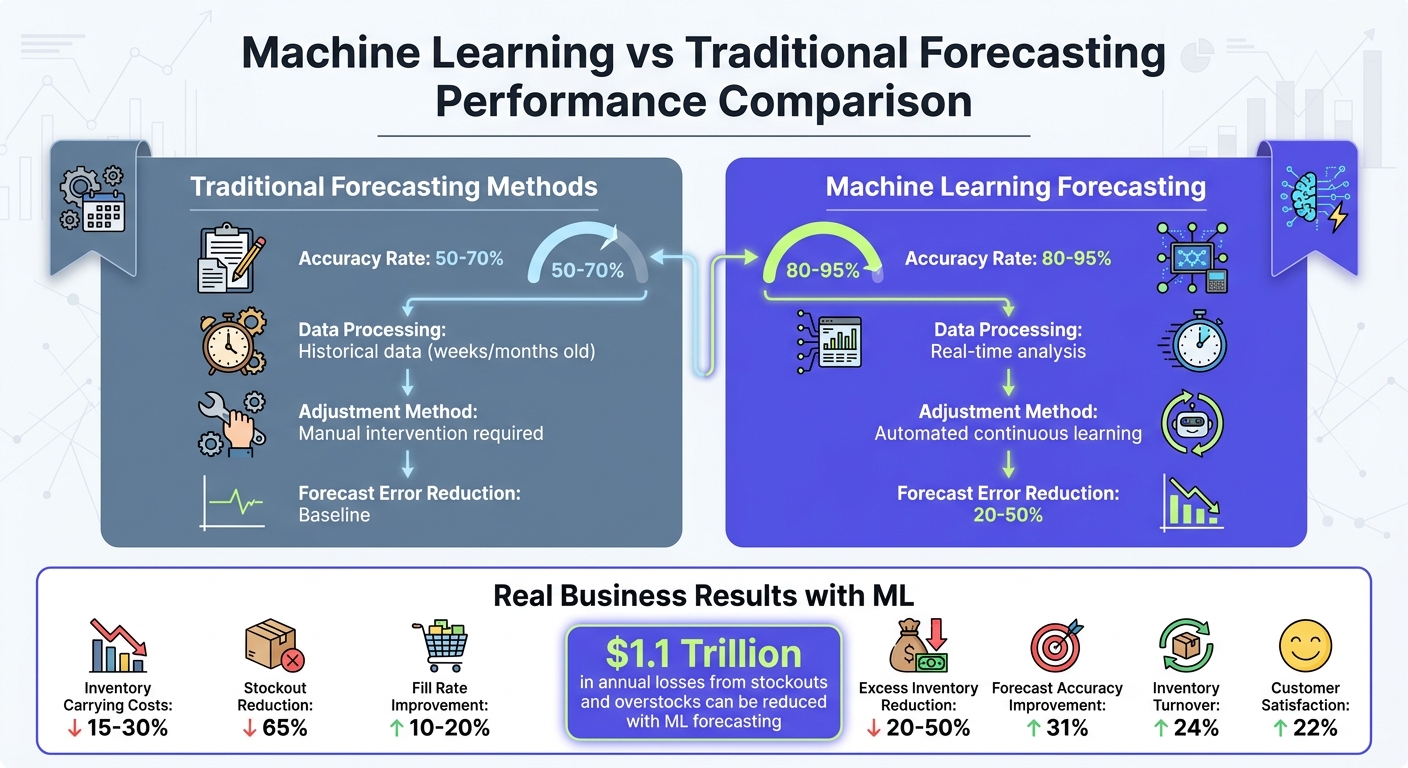
Machine Learning vs Traditional Forecasting: Accuracy and Performance Comparison
Data Science & Machine Learning for Demand Forecasting
sbb-itb-f0fc809
1. Real-Time Data Analysis
Traditional forecasting often relies on outdated historical data, sometimes weeks or months old. Machine learning takes a completely different approach by analyzing live sales data as it comes in. This transforms forecasting into a forward-looking tool rather than a backward-looking analysis.
This method, often called "demand sensing", is a step up from monthly sales reviews. Instead of waiting for quarterly or monthly reports, machine learning models analyze real-time inputs like point-of-sale (POS) data, website activity, social media trends, and even local weather conditions. For instance, if a product suddenly gains popularity on social media or an unexpected cold front increases demand for winter clothing, the system detects these shifts early, allowing businesses to respond before trends escalate.
The results are impressive. Demand sensing has been shown to reduce forecast errors by 33%, with companies seeing improvements in the range of 20–50% and up to 65% fewer stockouts. This kind of real-time insight allows for immediate adjustments to inventory, keeping supply chains in sync with current demand.
Another advantage is the elimination of sequential lag - the delays caused by slow data movement between sales, inventory, and procurement. Machine learning enables all functions to access and act on changes simultaneously, using a single, unified data source. For example, when Forstock identifies a sudden sales increase, it doesn't just update a report; it adjusts reorder points and safety stock levels across the board, ensuring purchasing decisions align with current demand.
2. Continuous Learning and Adjustments
Machine learning doesn’t just collect data - it evolves. Unlike traditional forecasting models, which rely on static datasets and fixed parameters, machine learning thrives on continuous updates. It adapts to real-time changes in market conditions, refining predictions without needing constant human oversight.
This process hinges on feedback loops. Here’s how it works: the model makes a prediction, compares it to actual outcomes, and automatically tweaks its parameters. This allows it to pick up on subtle changes in customer behavior, weather patterns, social media trends, and other key indicators. If the updated model outperforms its predecessor, it takes over. If not, the original model stays in place.
"Today, we're no longer operating in a system of averages. We're operating in a system of exceptions. That's where machine learning changes the game." – Sarah Harkins, Kinaxis
The results are impressive. Companies using machine learning for forecasting have seen accuracy improvements of up to 31% in large-scale retail settings. These systems can also reduce inventory levels by 20% to 30% and cut forecasting errors by 20% to 50%. One standout example: a global food manufacturer slashed the time needed to create production schedules by an astonishing 96% using AI-driven forecasting.
Forstock takes this concept further by automating adjustments to reorder points, safety stock levels, and demand plans. As new sales data comes in, the platform instantly updates forecasts, ensuring decisions are based on current market realities - not outdated information. This real-time adaptability keeps businesses agile and responsive.
3. Seasonality and Pattern Recognition
Machine learning has a knack for revealing seasonal trends that traditional methods often overlook. While older approaches might treat seasonality as a simple, repetitive cycle, real-world demand is far more dynamic. It’s shaped by overlapping factors like annual holidays, weekend shopping habits, and major events such as Black Friday or Prime Day.
Tools like Facebook Prophet and SARIMA use historical data to identify these patterns with precision. The result? Far better forecasting accuracy. For instance, seasonal products see prediction accuracy jump from around 50–70% to 80–95%, while fashion items improve from 45–60% to 70–82%. On top of that, businesses can reduce inventory carrying costs by 15–30%.
One of ML’s standout abilities is distinguishing between baseline demand and spikes caused by promotions. By separating natural seasonal peaks from marketing-driven surges, machine learning ensures that temporary sales boosts don’t distort future predictions.
"Knowing which products sell out right away versus sit on our shelves for months until Christmas is important... so we... are able to order ahead so artisans have time to produce inventory." – Sylvia Fountaine, Owner, Feasting at Home
This level of pattern recognition is a game-changer for forecasting. Platforms like Forstock integrate these advanced techniques to adapt to seasonal trends. By analyzing sales data, lead times, and seasonal cycles, the system enables Shopify brands to make smarter purchasing decisions. This means they’re ready for peak demand periods without risking stockouts, while also avoiding excess inventory during slower times.
4. Multi-Variable Analysis
Traditional forecasting often leans on a single factor - usually past sales. Machine learning (ML), on the other hand, takes it up a notch by analyzing dozens of variables at once, uncovering connections that would be impossible to spot manually.
ML models go beyond just real-time adjustments and automated learning. They use multi-variable analysis to refine forecasts, factoring in a wide range of demand drivers. Consumer demand isn’t just about seasonality - it’s shaped by pricing, promotions, weather, competitor actions, social media buzz, and even inventory availability. Advanced models like XGBoost and LightGBM treat forecasting as a regression problem, incorporating these diverse factors. They’re especially good at identifying non-linear patterns, such as how a specific price point, combined with a rainy weekend and a viral social media event, can influence sales in ways that traditional spreadsheets just can’t match.
The results speak volumes. Companies adopting ML-based demand planning have reported forecast error reductions of 20% to 50%. For instance, in August 2025, a major retail group rolled out an ML solution that combined sales data, promotions, and regional differences. The outcome? A 31% boost in forecast accuracy, a 24% increase in inventory turnover, and a 22% jump in customer satisfaction.
"The missing signal is in the relationships: substitution effects when a product goes out of stock, promotional lift that propagates across categories, and supplier constraints that affect availability across your catalog." – Kumo.ai
ML tools also break down the impact of promotions by separating baseline demand from temporary surges. For example, a 20% off email campaign won’t distort future predictions. They even tackle cannibalization, analyzing how introducing a new product might affect demand for existing ones. Forstock takes this a step further by integrating sales trends, lead times, and external factors, giving Shopify brands a clearer understanding of what drives demand. This kind of integrated approach highlights how ML transforms inventory management, enabling smarter, data-backed purchasing decisions.
5. Automated Error Correction and Bias Elimination
Human intuition can sometimes lead to inconsistencies in forecasting. For example, a planner might rely on a gut feeling to override predictions or adjust seasonal factors differently each quarter. Machine learning (ML) steps in to eliminate these subjective tweaks, offering a consistent, data-driven approach that ensures every forecast is treated uniformly.
ML models go beyond just making predictions - they actively monitor their performance. By tracking metrics like "Bias", they can detect patterns where forecasts consistently overestimate or underestimate demand. When such systematic errors are identified, the models recalibrate automatically. This self-correction happens in real-time, without waiting for a human to spot the issue and fix it weeks later. This process not only sharpens the accuracy of predictions but also minimizes biases that often creep into traditional forecasting.
The results speak for themselves. While conventional demand planning methods usually achieve accuracy rates of 50% to 70%, ML-powered systems can hit levels of 80% to 95%. By removing the subjective adjustments inherent in manual models, companies have shown how automated error correction can resolve the inconsistencies that undermine traditional forecasting.
"Traditional forecasting cannot factor in new variables and adjust their inter-relationships without human intervention. In contrast, machine learning is self-sufficient and can perform this role." – Telmo Silva, CEO, ClicData
Advanced graph-based ML takes this a step further by uncovering subtle relationships between products. For instance, when one item is out of stock, the system identifies shifts in demand toward substitutes - something human planners often miss. On the SAP SALT benchmark, graph-based ML achieved an impressive 89% accuracy, significantly outperforming expert-tuned models that relied on manual feature selection, which only reached 75%.
For Shopify brands using tools like Forstock, this automated bias correction works seamlessly with real-time analysis and adaptive learning. Forecasts are continuously refined without the need for constant manual intervention, allowing businesses to focus on strategic growth rather than spending time on tedious spreadsheet updates.
Conclusion
Machine learning is reshaping demand forecasting by addressing the shortcomings of older methods. Techniques like real-time data analysis, continuous learning, seasonality recognition, multi-variable analysis, and automated error correction work in unison to tackle the forecast accuracy gap that contributes to $1.1 trillion in annual losses from stockouts and overstocks.
While traditional forecasting methods typically hit 50–70% accuracy, machine learning models achieve 80–95%. This improvement translates into tangible benefits: a 15–30% reduction in inventory carrying costs, a 10–20% boost in fill rates, and a 20–50% cut in excess inventory. For Shopify merchants juggling complex inventories across multiple locations, these advancements mean fewer missed sales, better cash flow, and the ability to scale operations with confidence.
Machine learning’s precision allows merchants to make smarter, data-driven decisions. Tools like Forstock integrate these capabilities into the Shopify ecosystem, delivering AI-driven forecasts tailored to sales trends, lead times, and seasonal demand and lead times. With daily SKU-level forecasts, merchants gain the clarity needed for precise purchasing decisions.
"The shift from spreadsheet-based demand planning to ML-powered forecasting is not a technology project - it is an operations transformation that happens to use technology." - ECOSIRE Team
FAQs
What data do I need to start ML forecasting?
To get started with machine learning forecasting, you’ll need historical data that shows clear patterns and trends. This includes past values of the target variable along with related features, such as seasonal changes or external influences. Make sure the data is organized as a time series with consistent intervals - whether that’s daily, hourly, or another regular timeframe. The cleaner and more complete your data, the better the model can detect relationships and seasonal patterns, which ultimately leads to more accurate predictions.
How fast do ML forecasts update with new sales?
Machine learning models have the ability to update forecasts in real-time - or very close to it - whenever new sales data becomes available. This constant adjustment ensures that demand predictions remain current, allowing businesses to react swiftly to shifting trends and evolving customer preferences.
How does ML handle promotions without skewing demand?
Machine learning handles promotions by diving into real-time data and tweaking forecasts to reflect temporary sales spikes. This approach avoids overestimating demand during promotional events, keeping forecasts precise and dependable.


.png)
.png)
.png)
.svg)