

.png)
.png)
Seasonal inventory planning helps businesses align stock levels with customer demand, reducing excess inventory and avoiding stockouts. Poor planning can lead to unsold goods, high carrying costs, and lost sales opportunities. Here's what you need to know:
- Avoid using annual averages: They overlook demand spikes and slow periods.
- Understand carrying costs: These include storage, utilities, insurance, and lost opportunities, totaling about 26% of inventory value annually.
- Leverage data: Analyze at least two years of sales data to identify demand trends and calculate seasonal indexes.
- Forecast demand: Use AI tools or manual methods to predict demand accurately, reducing overstock and shortages.
- Implement smart stocking strategies: Use staggered purchasing, FIFO, and ABC analysis to manage inventory efficiently.
- Adjust safety stock: Scale buffers based on peak and off-peak seasons to balance availability and costs.
- Clear excess inventory: Use markdowns, bundling, or liquidation to avoid dead stock.

Seasonal Inventory Management: Key Metrics and Cost Breakdown
Understanding Carrying Costs and Seasonal Demand
What Are Carrying Costs?
Carrying costs include all the expenses tied to storing and maintaining inventory until it’s sold. On average, these costs account for about 26% of your total inventory value each year. A significant chunk comes from capital costs - this includes the money invested in inventory and any related financing fees. Essentially, this is cash tied up that could have been used elsewhere, like funding marketing initiatives or creating new products.
Other expenses include storage costs such as rent, utilities, security, taxes, and upkeep. There are also labor costs for handling inventory, insurance premiums, depreciation, and losses from obsolescence. Don’t forget opportunity costs - this is the potential gain you miss out on because your money is stuck in inventory. Administrative costs for tracking systems and shrinkage from theft or damage also contribute to the total. For instance, Pepper Palace saved $20,000 annually by centralizing their inventory system.
To manage these costs effectively, it's crucial to understand how seasonal demand plays a role.
Using Data to Identify Seasonal Trends
Dive into at least two years of sales data to distinguish recurring seasonal patterns from one-off anomalies. Instead of focusing solely on total revenue, examine how quickly inventory moves during peak and off-peak periods by tracking units sold per day. This approach gives a clearer picture of inventory turnover. Pay close attention to SKU-level data, as seasonality often affects specific products or variants differently.
Seasonal indexes are a helpful tool. For example, if December sales are 250% of the monthly average, the index would be 2.5. A clothing retailer studying cotton sweater sales discovered layered seasonality: sales were four times higher in fall and winter compared to spring and summer, with an added 50% boost during back-to-school shopping and a threefold increase during promotional weeks. Beyond holidays, look for other factors like weather changes, school calendars, and industry-specific events that might influence demand. Also, compare trends across sales channels - marketplaces might see demand spikes earlier than your direct-to-consumer site.
sbb-itb-f0fc809
Strategies for Seasonal Inventory Management
Forecasting Demand Accurately
To manage seasonal inventory effectively, start by categorizing your stock into four groups: highly seasonal items (like swimwear), moderately seasonal products, year-round staples, and counter-seasonal goods. This classification allows you to allocate resources more strategically. A good way to understand demand is by calculating seasonal indexes - divide actual demand for a specific period by the average demand across all periods.
Keep an eye on daily sales to measure how quickly stock moves during peak seasons. External factors like weather changes, school schedules, or even viral trends on TikTok can also disrupt typical seasonal patterns, so stay flexible.
Modern tools like AI-powered forecasting models, such as SARIMA and Neural Networks, take forecasting to the next level. These systems analyze patterns across years, months, and even days of the week, adapting to real-world data as it evolves. For example, platforms like Forstock use AI to track sales trends, lead times, and seasonality, offering a 12-month demand plan. This data-driven approach helps you anticipate shifts and make smarter purchasing decisions. Accurate forecasting reduces surplus inventory and cuts down on unnecessary holding costs.
Once you have reliable forecasts, focus on aligning your purchasing strategy to ensure stock arrives when demand peaks.
Stocking Efficiently with Inventory Management Methods
A staggered purchasing strategy works well for seasonal items. Start with an initial buy covering 60–70% of your projected needs, then follow up mid-season with another 20–30%, and finally, a smaller 10–15% fill-in for bestsellers. This approach avoids over-committing to a single large order, especially when forecasts are uncertain.
For perishable or seasonal goods, use the FIFO (First In, First Out) method to sell older stock first and maintain accurate inventory valuation. A Just-in-Time (JIT) strategy can also help by keeping inventory levels low and receiving stock only when needed. Another useful tool is the Economic Order Quantity (EOQ) model, which calculates the ideal order size by balancing demand with ordering and holding costs.
ABC Analysis is another helpful technique. It divides inventory into three categories: "A" items (high-value, high-profit), "B" items (mid-tier), and "C" items (low-value but high-velocity). This method helps prioritize purchases and avoid obsolescence of high-value goods. Additionally, focus on "seasonal windows" instead of relying on annual averages - by isolating specific 4-week or monthly periods, you can better identify true demand peaks.
Efficient stocking lays the groundwork for adjusting safety stock levels dynamically as seasons change.
Building Safety Stock and Buffers
Adjusting safety stock levels based on the season is crucial. During peak times, increase stock buffers to avoid running out, but scale them back during slower periods to reduce carrying costs. Holding too much inventory during off-seasons can tie up cash unnecessarily.
A good rule of thumb is to maintain inventory at about 70% of peak levels, ensuring smoother transitions between seasons. When planning lead-time buffers, consider the longest delays during peak seasons rather than relying on average lead times. This approach helps mitigate risks from supplier or shipping delays. Monitoring "Days of Supply" in real time is also essential to identify when stock is nearing critical levels or becoming stagnant.
"One way I manage seasonal inventory is by offering presales. It allows me to have cash flow before investing in the inventory and shows me what the customers are most eager to purchase."
– Meredith Dew, Owner, Wild Melon
To handle late-season inventory, establish markdown triggers at specific stock levels to clear items before they turn into dead stock. Negotiating flexible terms with suppliers - such as reserved capacity during peak seasons or partial shipments - can also help spread out arrivals and reduce risks from overstocking. By proactively managing buffers, you align inventory with real-time demand and keep carrying costs in check.
Shopify Inventory Management: Dominate Peak Season With These Proven Strategies!

Practical Steps to Reduce Carrying Costs
These steps turn strategic forecasts into direct, actionable inventory changes, helping to cut carrying costs effectively.
Pre-Season Planning and Adjustments
Using demand forecasting, make pre-season adjustments to sync inventory with market needs. Start planning 2–4 months before peak seasons to account for production, shipping, and fulfillment timelines. Tailor strategies to specific inventory categories for better results.
Negotiate early for reserved production capacity, partial shipments, or seasonal payment terms. Running presales can secure cash flow before committing to large inventory investments and reveal customer interest in specific products.
For bulky items, consider displaying select models in-store while fulfilling orders from a central location. Wildling, a footwear retailer, adopted this strategy with Shopify POS, saving $10,000 and boosting stock availability by 5%. Additionally, U.S. retailers can sell surplus summer inventory in counter-seasonal markets like Australia or New Zealand starting in April, avoiding steep local discounts.
Post-Season Clear-Out Strategies
Identify slow-moving inventory 6–8 weeks before the season ends to recover 35–55% of costs; waiting longer (3–4 months) reduces recovery to just 10–20%. Set clear triggers - if sell-through is below 70–80% when 75% of the season has passed, start markdowns immediately.
Use a tiered markdown schedule with pre-set discount levels and minimum margins to clear stock systematically. Bundling can also help - pair slow-moving items with popular products or create value kits to increase sales volume. For leftover inventory, consider liquidation firms, online platforms like B-Stock, or off-price retailers to clear large volumes.
"Proactive liquidation is not an admission of failure. It is an exercise in financial discipline."
– Liquidate Products
Holding onto slow-moving seasonal stock can cost $300–$600 per pallet in off-season warehousing alone, so clearing inventory quickly is critical. After clearing stock, track performance metrics to improve future planning.
Monitoring Metrics for Continuous Improvement
During peak seasons, track metrics like sales velocity and in-stock rates to prevent stockouts and manage costs. Post-season, review sell-through rates, markdown percentages, and carryover values to refine your strategy.
Key metrics to monitor include:
| Metric | When to Track | What It Tells You |
|---|---|---|
| Sales Velocity | In-Season | How quickly inventory sells during peak periods |
| Seasonal In-Stock Rate | In-Season | Percentage of demand met without stockouts |
| Sell-Through Rate | Post-Season | Portion of inventory sold at full price |
| Markdown Percentage | Post-Season | Discounts required to clear inventory |
| Recovery Rate | Post-Season | Percentage of costs recovered through liquidation |
Analyze inventory at the SKU or variant level rather than broad categories, as seasonality can impact specific items like particular colors or sizes. After each cycle, compare forecasted demand with actual sales to identify the causes of overstock or stockouts. Document these findings to refine future inventory planning and maintain a cycle of continuous improvement. This approach will help you reduce carrying costs while better aligning with customer demand.
Using Forstock for Inventory Optimization
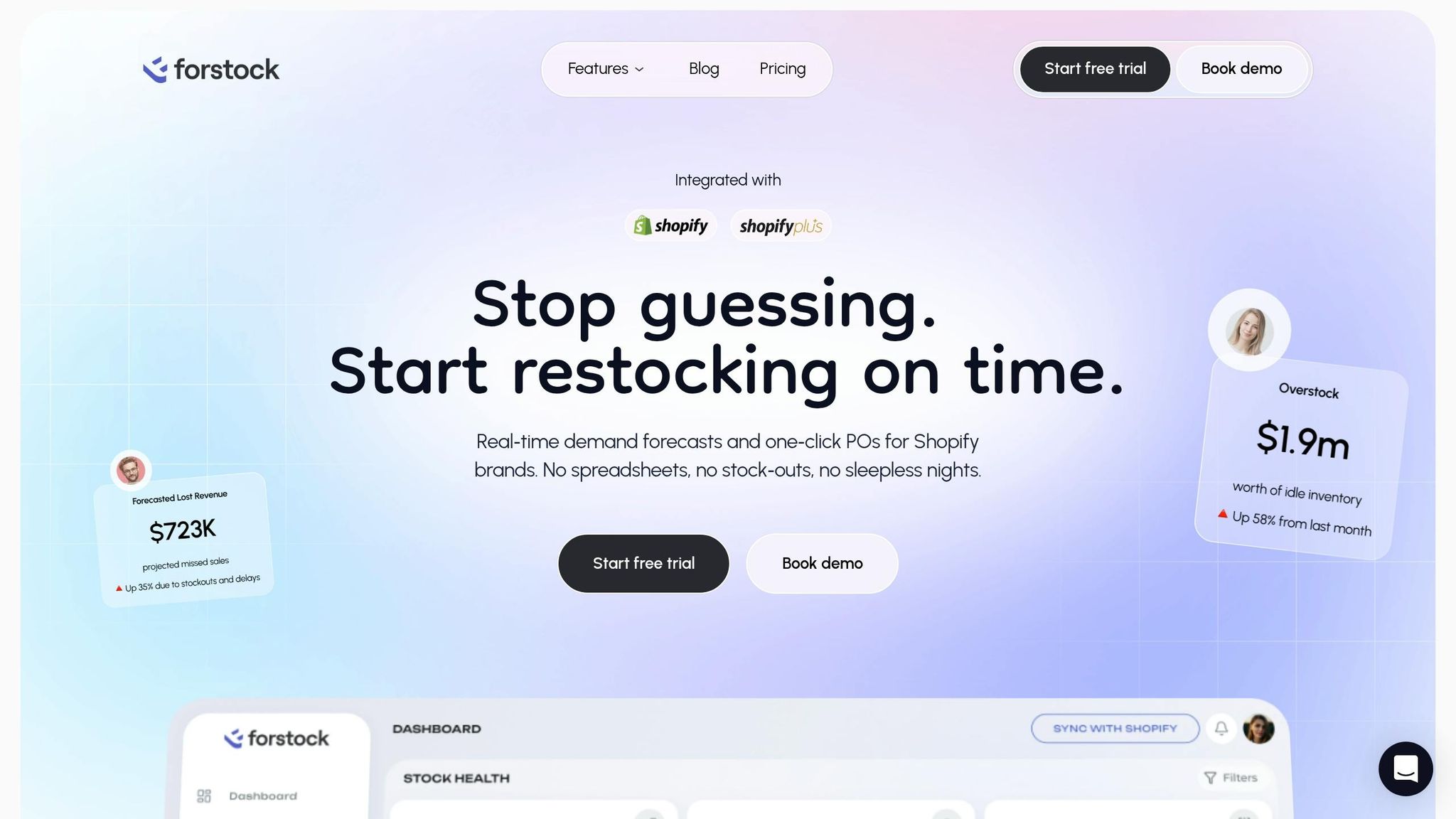
Managing inventory with spreadsheets often leads to overstocking vs. stockouts. Forstock, a SaaS platform built for Shopify brands, simplifies this process by automating inventory planning, forecasting, and purchase order management. By syncing directly with your Shopify catalog, it eliminates the need for manual data entry and offers clear visibility into stock levels, supplier performance, and demand trends. These tools make inventory management more efficient and reliable for Shopify businesses.
Key Features of Forstock
Forstock uses AI-powered demand forecasting to analyze your Shopify store's historical data, identifying trends, seasonal patterns, and growth opportunities. This helps prevent tying up cash in excess inventory. The platform also streamlines order management by automating the creation, splitting, and tracking of purchase orders. Its Reorder Table calculates exactly which products need restocking and when, using real-time sales data and supplier lead times to align inventory with actual demand.
The centralized inventory dashboard offers instant insights into key metrics like turnover, stock value, and overstocked items. It also highlights slow-moving products, allowing for quicker decisions. Real-time alerts notify you before stockouts occur, helping avoid costly emergency shipping. Emily, an Inventory Manager, shares:
"I open the dashboard in the morning and instantly know what needs reordering, what is overstocked, and what to focus on."
Users have reported a 60% reduction in manual tasks, freeing up time for more strategic activities, especially during busy seasons.
Manual vs. Automated Inventory Management
The contrast between manual and automated inventory management is striking. Spreadsheets require constant updates, are prone to errors, and often lead to reactive decisions - causing overstocking or stockouts. On the other hand, Forstock leverages AI to provide proactive, real-time insights, accounting for seasonality and demand fluctuations.
| Method | Carrying Cost Impact | Time Saved | Accuracy |
|---|---|---|---|
| Manual (Spreadsheets) | High (overordering likely) | Low (time-intensive) | Moderate (error-prone) |
| Forstock (Automated) | Low (optimized inventory) | High (60% task reduction) | High (AI-driven precision) |
Sophie, an E-commerce Manager, highlights the difference:
"Since switching, I haven't had a single stockout, and I don't overorder anymore. The AI forecast actually makes sense for my business."
Conclusion
Seasonal inventory planning is a smart way to protect cash flow while keeping your business on solid footing. Accurate forecasting helps you avoid two major pitfalls: excess inventory that ties up your capital and costly stockouts that can lead to missed sales opportunities - issues that cost retailers billions every year. Following a Shopify inventory management guide can help mitigate these risks. By syncing your inventory levels with actual demand trends, you can redirect funds toward growth-focused efforts like marketing or product innovation, instead of letting them sit in storage.
Automated tools like Forstock simplify inventory management, even during peak seasons, by identifying subtle seasonal trends and comparing manual vs. automated purchase orders. Javad Nasiry, a Professor at McGill University, emphasizes the importance of understanding demand:
"The more you know about your demand, the less uncertain you are about demand. That means you can manage your inventory better and reduce inventory levels in your warehouses, because keeping inventory is costly".
These automated solutions work hand-in-hand with practical strategies to streamline inventory management.
FAQs
How do I calculate a seasonal index for a SKU?
To figure out a seasonal index for a SKU, follow these steps:
- Gather sales data: Collect several years' worth of sales information for the SKU, broken down by specific periods like months or weeks.
- Determine the average sales for each period: Calculate the average sales for each period by combining the sales data across the years and dividing by the number of years.
- Calculate the overall average sales: Add up all the period averages and divide by the total number of periods.
- Compute the seasonal index: For each period, divide its average sales by the overall average sales. This gives you the seasonal index, which reflects how sales fluctuate relative to the average.
How much safety stock should I keep in peak vs. off-season?
Safety stock levels should align with how much demand fluctuates and past sales patterns. For busy seasons, it’s smart to maintain higher safety stock to accommodate spikes in demand and possible delays in supply chains. On the flip side, during slower periods, reducing safety stock can help prevent overstocking. By analyzing historical sales data and leveraging tools like AI-powered forecasting, you can fine-tune stock levels for both peak and off-peak times, keeping them closely aligned with actual demand.
When should I start markdowns to avoid dead stock?
Start applying markdowns as soon as you spot slow-moving inventory or items that are unlikely to sell at full price during their season. Timing is key - early markdowns, particularly during seasonal shifts or when sales start to dip, can help you clear out excess stock before it turns into dead stock. By lowering prices strategically during these periods, you can reduce unsold inventory while still safeguarding your profit margins.


.png)
.png)
.png)
.svg)