

.png)
.png)
When onboarding a SaaS tool like Forstock, you have two main training options: Customer Support (live help from experts) and Self-Service (resources you explore independently). Each has its strengths, and choosing the right mix can impact how effectively your team uses the software. Here’s a quick breakdown:
- Customer Support: Ideal for complex issues like API errors, billing disputes, or advanced feature setup. Offers personalized help via live chat, email, or phone. Best for urgent or intricate problems.
- Self-Service: Best for routine tasks like managing Shopify inventory or generating reports. Includes FAQs, tutorials, and AI chatbots. Available 24/7 and cost-effective.
Quick Comparison
| Factor | Customer Support (Live) | Self-Service (Digital) |
|---|---|---|
| Cost per Interaction | $8.01 (avg.) | $0.10 (avg.) |
| Availability | Business hours | 24/7 |
| Response Time | May vary (wait times) | Instant |
| Scalability | Limited (staff needed) | Unlimited |
| Best For | Complex issues | Simple, repetitive tasks |
For top results, combine both methods. Use self-service for straightforward needs and live support for complex challenges. This approach saves time, reduces costs, and ensures your team gets the help they need when they need it.
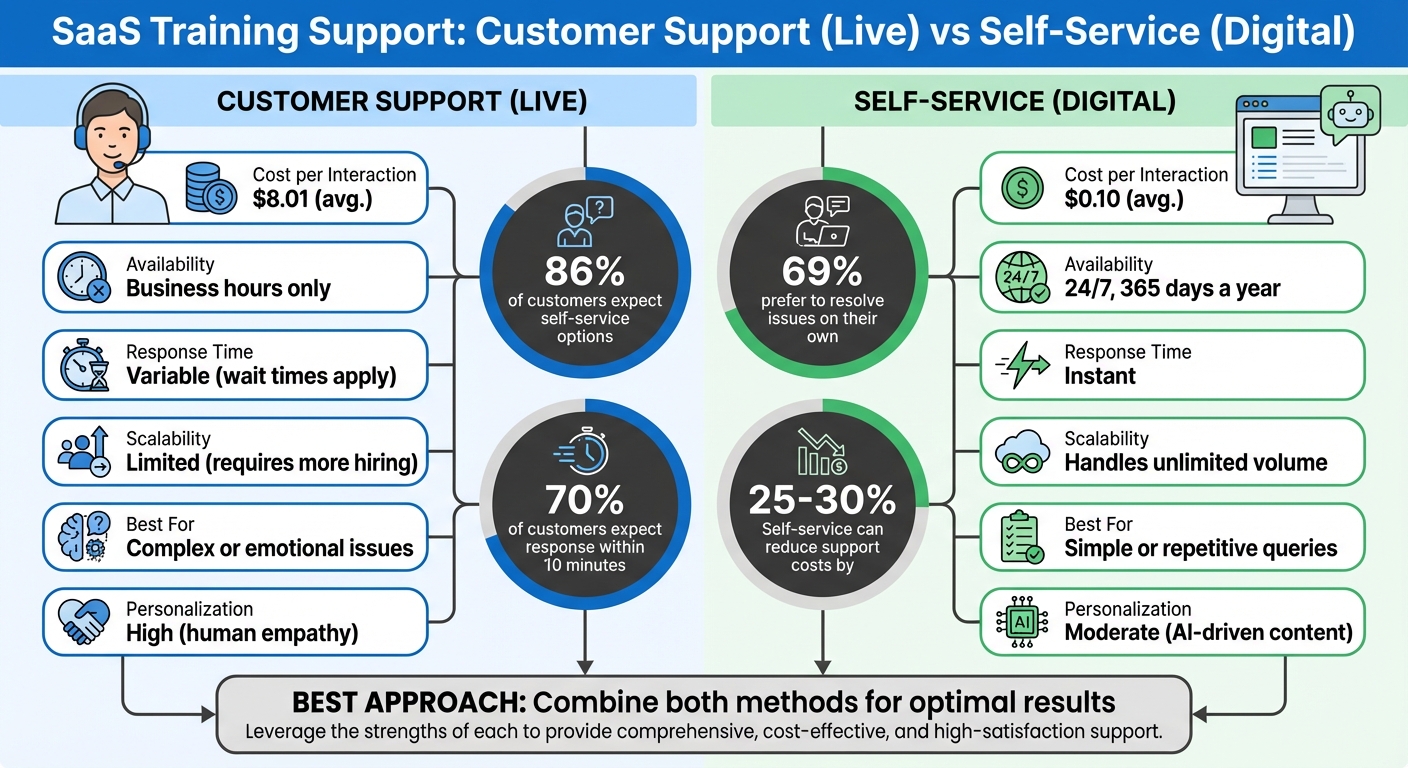
Customer Support vs Self-Service: Cost, Availability, and Scalability Comparison
Build Your SaaS Customer Support System
sbb-itb-f0fc809
Benefits of Customer Support for SaaS Training
Customer support plays a vital role in making the most of your Forstock experience, especially when navigating advanced features or overcoming operational challenges.
Personalized Help for Advanced Features
Live support can make a world of difference when tackling complex inventory management tools. Whether you're setting up AI-powered demand forecasting or configuring automated purchase orders across multiple locations, a support agent can guide you through the process step by step. This hands-on assistance is particularly valuable when dealing with features that require detailed, technical instructions.
"Your team needs to be armed with intimate product knowledge to guide customers through the various use cases for your product. Otherwise, you risk high churn rate and low adoption rate."
– Nicholas Walters, Writer & Editor, Groove
Support teams also provide tailored solutions for unique inventory challenges, such as managing seasonal demand or optimizing supplier lead times. For instance, eyewear company Shady Rays improved its warehouse setup and streamlined processes with expert guidance, enabling them to scale their operations significantly. At Forstock, our live chat support ensures users can confidently master advanced features with personalized guidance designed to address their specific needs.
Of course, resolving issues quickly is just as crucial.
Fast Problem Resolution
When integration errors or data sync issues arise, speed is everything. In fact, over 70% of customers expect a response within 10 minutes. Companies like Blueink have set the bar high, with average response times of under 3 seconds. As Bianca DeNora, Director of Customer Success, explains: "People are busy, and they don't want to waste time searching for answers when using a SaaS platform. They want to get answers quickly."
Quick problem-solving minimizes downtime, ensuring that disruptions - like syncing errors or unexpected forecasting glitches - are resolved in minutes instead of dragging on for hours.
Support During Peak Seasons
Busy periods like Black Friday or the holiday season demand fast, effective assistance. Live support becomes essential during these times, allowing businesses to respond to real-time data, handle reorders, and reallocate stock efficiently. Additionally, support teams can help manage seasonal inventory challenges, such as surpluses and return spikes. Considering that nearly 60% of retailers' inventory records are inaccurate, having live support on hand to perform audits and spot checks ensures that financial records align with physical stock, avoiding forecasting errors during critical moments.
Benefits of Self-Service for SaaS Training
While live support offers personalized assistance, self-service training provides a unique set of advantages, giving users the tools to learn and solve problems independently. These resources put the power in your hands, letting you troubleshoot and explore solutions without waiting for support.
24/7 Availability
One of the biggest perks of self-service is its round-the-clock accessibility. Whether you're fine-tuning demand forecasting at 2:00 AM or resolving a purchase order issue on a Sunday, Forstock's knowledge base, video tutorials, and FAQs are always at your fingertips. This immediate availability eliminates the need to wait for business hours. It's no surprise that 86% of customers expect self-service options, and 69% prefer to resolve issues on their own.
In 2024, Unity demonstrated the power of self-service by deflecting nearly 8,000 support tickets, saving about $1.3 million. As David Schroeder, Senior Manager of Services Support at Unity, shared:
"Last year, we deflected almost 8,000 tickets due to self-service enabled by Zendesk. That amounts to about $1.3M saved due to the reduction in tickets."
Cost Efficiency and Scalability
Self-service isn’t just convenient - it’s also cost-effective. While live support averages $8.01 per contact, self-service costs just $0.10 per interaction. Even better, a single self-service platform can accommodate thousands of users without requiring additional staff.
Consider Lush, whose AI-powered self-service approach boosted productivity by 50%, delivered a 369% ROI, and saved approximately $434,000 annually. Similarly, Miko, a consumer robotics lab, achieved an impressive 93% self-service solve rate by using generative AI. This allowed them to handle a 12- to 15-fold increase in support volume during the holiday season without scaling up their team.
Encouraging User Independence
Self-service tools empower users to tackle complex tasks on their own. With step-by-step guides, video walkthroughs, and FAQs, users can confidently manage inventory processes - whether it's configuring multi-location tracking or adjusting seasonal demand settings. Mark Sherwood, CX Strategist, highlights this benefit:
"Self-service delivers answers in seconds or minutes, not hours or days"
Reverb, a marketplace for musical instruments, used self-service to significantly cut down daily support emails. Less than 10% of help center searches resulted in support tickets, and their customer satisfaction score jumped from 94% to nearly 98%. With Forstock's self-service tools, users can master inventory management while dedicating more time to strategic growth.
Self-service not only saves time and money but also builds a foundation for efficient, independent operations. Up next, we’ll look at how to choose between support options based on different scenarios.
Customer Support vs. Self-Service: Key Differences
Understanding the main differences between customer support and self-service can help you decide which approach works best for your needs. Let’s break it down by cost, accessibility, and scalability to make things clearer.
Cost is a major factor. On average, live customer support costs $8.01 per interaction, while self-service comes in at just $0.10 per interaction. This dramatic difference allows businesses to reduce support costs by 25%–30% when they implement self-service options.
Accessibility is another key distinction. Self-service options like FAQs, chatbots, and knowledge bases are available 24/7, no matter the time zone, and eliminate wait times. In contrast, live support is often limited to business hours. Research shows that 50% of customers pick a support channel based on how quickly they need help, and 40% base their choice on the complexity of their problem.
Scalability also sets these two apart. Self-service tools - such as AI-driven systems and online resources - can handle an increasing number of users without requiring additional staff. In fact, 83% of customer experience leaders anticipate a five-fold increase in self-service interactions soon. On the other hand, live support requires hiring more agents as demand grows, making it less scalable.
Comparison Table: Customer Support vs. Self-Service
| Factor | Customer Support (Live) | Self-Service (Digital) |
|---|---|---|
| Cost per Interaction | High (Avg. $8.01) | Low (Avg. $0.10) |
| Availability | Limited to business hours | 24/7, 365 days a year |
| Response Time | Variable (wait times apply) | Instant |
| Scalability | Requires more hiring | Handles unlimited volume |
| Ideal Use Case | Complex or emotional issues | Simple or repetitive queries |
| Personalization | High (human empathy) | Moderate (AI-driven content) |
These differences explain why customers often turn to self-service for straightforward questions and rely on live support for more complicated or sensitive issues. For example, 61% of customers prefer self-service for resolving simple problems. However, when it comes to complex or high-stakes challenges, live agents - who can provide creativity and empathy - are the go-to option.
Interestingly, nearly 40% of Gen Z customers will abandon a service issue altogether if they can’t resolve it on their own. This highlights the growing importance of offering effective self-service solutions alongside traditional support.
When to Use Customer Support
Knowing when to rely on live customer support can make all the difference, especially in situations that are complex, urgent, or high-stakes. While self-service options are great for straightforward issues, there are times when only a skilled human agent can provide the creativity and problem-solving necessary to resolve a problem. This complements the earlier point about self-service cost-efficiency by highlighting the scenarios where human expertise is simply irreplaceable.
Complex onboarding: Live support is invaluable during intricate onboarding processes, such as setting up demand forecasting models, integrating systems, or configuring multi-location tracking. For SaaS inventory platforms like Forstock, onboarding can take anywhere from a few days to several months. The process often begins with an exploratory meeting to identify technical gaps and shape a customized training plan. According to Sacha Ferrandi, Founder of Source Capital Funding:
"Consider this meeting as a massive Q&A where the extent of the client's knowledge on your system is revealed... Do not waste time working on a checklist until after you carry out this exploratory meeting".
Integration troubleshooting: When connecting inventory systems to supplier databases, payment processors, or shipping platforms, errors can arise that automated tools simply can't address. These situations call for real-time, adaptive problem-solving. Support teams with experience in the industry can bridge technical gaps and explain complex issues in ways that are easy for non-technical users to understand.
Peak sales periods and urgent issues: Events like Black Friday, the holiday shopping season, or sudden demand spikes leave no room for downtime. Problems such as service outages, billing errors, or forecasting mishaps during these critical windows require immediate human intervention. Research shows that two-thirds of customers value their time above all else when interacting with a company, and over 70% will switch to a competitor after multiple poor support experiences. Even a modest 5% increase in customer retention can lead to a 25% boost in profits.
Live support is also essential when decisions demand human judgment. For instance, a customer might need emergency access to deleted historical inventory data or expedited purchase order approvals outside standard workflows. These "edge cases" fall outside documented procedures and require someone who can assess the situation, weigh the business impact, and make decisions that balance company policies with customer needs.
When to Use Self-Service
Self-service shines when users need quick solutions to straightforward problems or prefer to learn at their own speed. Tasks like resetting passwords, adding stock items, or checking basic shipping policies are ideal for this approach. These simple queries don’t require the involvement of a live agent, saving time for both the user and the support team. On the other hand, more complicated issues - like onboarding or integration challenges - are better suited for live support, where human expertise is essential. Interestingly, research highlights that 69% of customers prefer solving issues on their own, and 86% expect brands to offer self-service options.
One major advantage of self-service is its ability to cut down support costs. For instance, in 2024, Unity managed to deflect nearly 8,000 support tickets by leveraging self-service tools. This resulted in notable cost savings and improved efficiency.
Self-service also proves invaluable for users working outside of regular business hours. Whether someone is auditing inventory late at night or managing stock across multiple warehouses and time zones, the 24/7 availability ensures they can access help without waiting for the next business day. For SaaS inventory platforms like Forstock, self-service is particularly effective for repetitive tasks and mastering standard workflows. Examples include generating basic reports, navigating demand forecasting dashboards, or reviewing supplier coordination features. Tools like video tutorials, searchable knowledge bases, and in-app tooltips allow users to learn these processes at their own pace, seamlessly integrating with their workflow. In fact, 79% of users value this round-the-clock access. By addressing specific needs, self-service becomes a key part of a comprehensive training strategy.
Using Both: A Combined Approach
When it comes to SaaS training, blending self-service tools with live support is a winning formula. This approach uses self-service options to handle straightforward issues - like adding a new SKU or checking stock levels - while reserving live agents for more complex problems, such as inventory reconciliation errors or API integration hiccups. The payoff? Faster resolutions, reduced costs, and satisfied users who feel supported without unnecessary hand-holding. Let’s dive into how to make the switch between these support types as smooth as possible.
Moving Between Support Options
The magic of this combined approach lies in smooth escalation. Users should be able to start with self-service tools, such as knowledge bases or AI chatbots, and easily transition to live support when their issue needs more attention. This avoids frustrating "bot loops" where users feel stuck. A great example is the musical instrument marketplace Reverb, which paired a knowledge base with an integrated support system. The result? Fewer than 10% of help center searches turned into support tickets.
An essential part of effective escalation is context sharing. When users switch from self-service to live support, integrated systems should provide agents with the user’s activity history. This eliminates the need for users to repeat themselves. For instance, on inventory platforms like Forstock, an agent might see that a user already reviewed a demand forecasting tutorial before reaching out about a specific calculation error. This streamlined transition not only saves time but also enhances the user experience, setting the stage for ongoing performance tracking and improvement.
Tracking Support Performance
To make this approach work, it’s critical to track key metrics. These include deflection rates, average handle time for escalated cases, and customer satisfaction scores. For example, Unity’s self-service tools deflected nearly 8,000 tickets, showcasing how much this strategy can cut costs.
Platforms like Forstock can take it a step further by integrating tracking tools directly into their support systems. These tools monitor which training materials users access before reaching out for help and highlight recurring gaps in content where users keep asking the same questions. This creates a feedback loop: live support interactions inform updates to self-service resources. If agents notice they’re repeatedly answering the same inventory-related question, that topic can be added to the knowledge base or turned into a tutorial video. By continuously refining both channels, this approach ensures scalable, efficient training while keeping the human touch for moments when it matters most.
Conclusion
Deciding on the best training approach for your SaaS inventory platform isn’t about choosing one over the other - it’s about knowing when each method shines. Self-service tools, like knowledge bases and AI chatbots, are fantastic for handling routine tasks such as checking stock levels or generating simple reports. But when it comes to more complex challenges, like troubleshooting integrations or resolving inventory discrepancies across multiple locations, nothing beats the insight of human expertise. That’s why a blended approach often makes the most sense.
Real-world results back this up. Take Lush, for example. In 2024, they introduced AI-powered self-service tools and saw a 369% ROI in the first year. They saved around $434,000 annually and boosted productivity by 50%. Importantly, they didn’t eliminate human support. Instead, they shifted their agents to focus on more intricate problems that automation couldn’t resolve. This strategy aligns with customer preferences - 69% of users prefer solving issues independently, but 40% choose their support channel based on the complexity of their problem.
The financial stakes are too high to ignore. A single misstep, like an incorrect reorder point or a flawed demand forecast, can lead to significant revenue losses. To avoid this, take a close look at your support tickets. Identify which issues can be resolved through self-service and which demand expert attention. Tracking your search-to-contact rate can also reveal where users struggle to find answers and still need to submit support tickets.
With self-service interactions expected to grow fivefold, investing in training resources now will prepare your business to scale without inflating support costs. Whether your inventory includes 100 SKUs or 10,000, the right balance of accessible self-service tools and skilled human support ensures your team can focus on growth, not repetitive troubleshooting. By combining agile self-service options with expert human intervention, you’ll reduce costly errors and set your business up for long-term success.
FAQs
What are the cost advantages of using self-service training instead of customer support for SaaS platforms?
Self-service training is a game-changer when it comes to cutting costs. Tools like searchable FAQs, video tutorials, and AI-driven help centers let users handle common issues on their own. This not only reduces support expenses but also trims down the need for a large customer support team.
Take platforms like Forstock, for example. Self-service tools make onboarding and training for new merchants much smoother while keeping expenses in check. By offering accessible resources - think step-by-step guides and automated assistance - businesses help users manage inventory efficiently without piling on operational costs.
How does combining customer support with self-service tools enhance SaaS training?
A thoughtful mix of customer support and self-service tools can make SaaS training both efficient and user-friendly. Tools like FAQs, knowledge bases, AI chatbots, and video tutorials offer users quick solutions to common questions, cutting down the need for live support. This frees up support agents to handle more complex or critical issues that require a personal touch.
By weaving self-service options into the training process, businesses can simplify onboarding, reduce support expenses, and boost user satisfaction. Plus, analyzing frequently asked questions helps refine these resources over time, creating a cycle where users get faster answers and better training materials. This balanced approach ensures users can learn at their own pace while still having expert help available when it matters most.
When should I use live customer support instead of self-service tools?
Live customer support is best suited for complex, urgent, or highly specific issues that can’t be fully addressed by self-service tools like FAQs or knowledge bases. Think about situations like fixing integration errors, handling unexpected inventory discrepancies, or getting clarity on advanced features. These kinds of problems often need a support agent’s personalized expertise to evaluate your situation and deliver tailored solutions. This becomes especially crucial when delays might result in revenue losses or disrupt operations.
Meanwhile, self-service tools shine when it comes to quick, routine tasks like resetting passwords, finding how-to guides, or generating standard inventory reports. But when your problem requires immediate attention, technical know-how, or a human touch, live support offers accurate solutions and a smoother experience. Forstock provides both live assistance for more intricate inventory challenges and dependable self-service tools for everyday tasks, giving you the flexibility to pick what works best for your needs.



.png)
.png)
.png)
.svg)